
Polkadot
826 Posts

Unstaking the Stakes
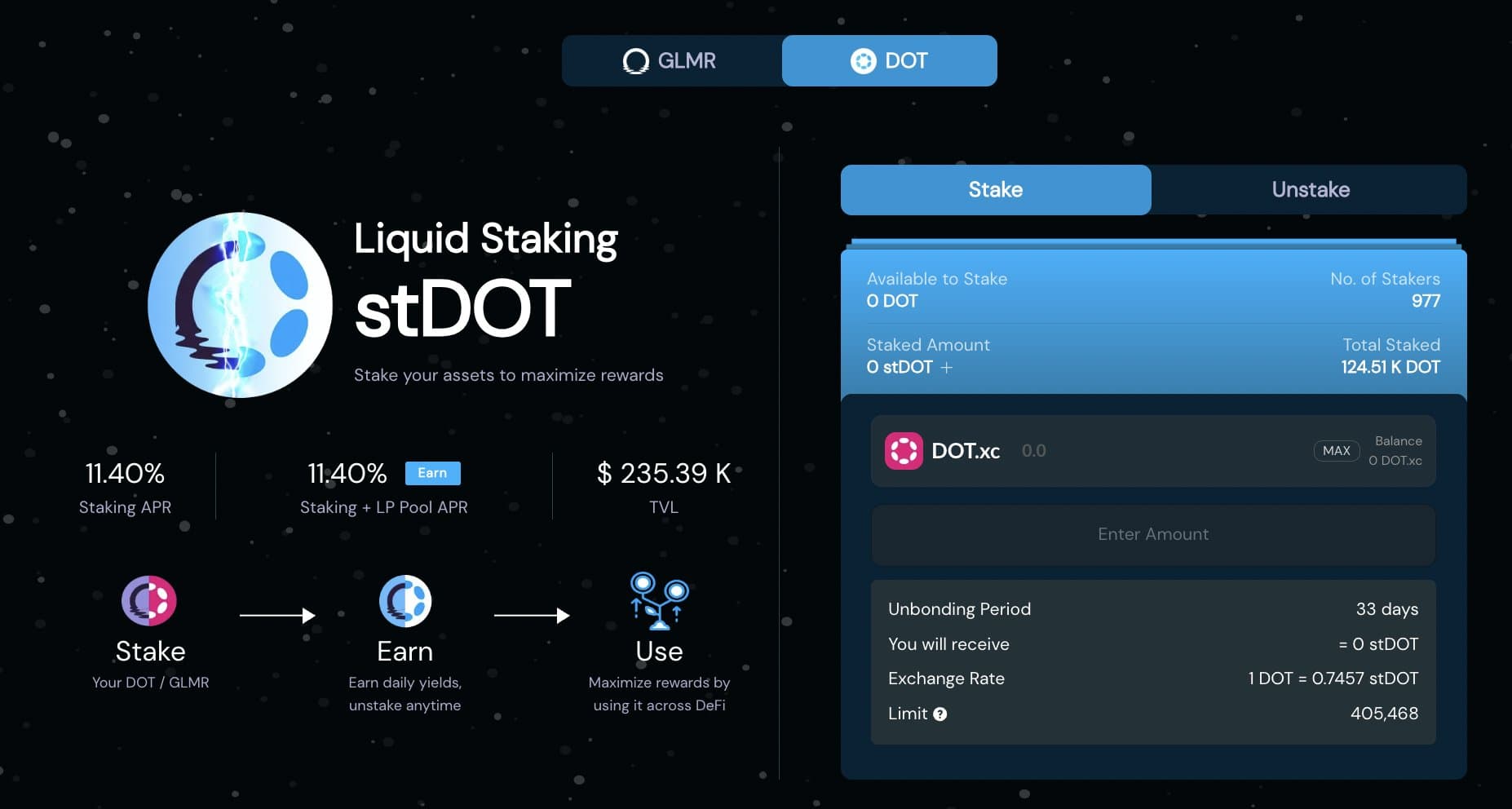
Due to prolonged technical hurdles following the Asset Hub migration and unsustainable maintenance costs, Stellaswap has decided to sunset the stDOT liquid staking token. Deposits are suspended, and remaining holdings are now unbonding, with redemptions available within 30 days.

 Paraverse
Foundation Puts the ‘You’ in Support
Web3 Foundation is winding down the official Polkadot Support operation. The support page will remain but will no longer be maintained, and the contact form will be disabled in a week, with only outstanding tickets addressed. Going forward, support will shift to the community via Polkadot's Discord, Reddit, and Telegram channels.
Re-bridging the Divide
Polkadot Referendum 1840, now passed, deployed runtime 2.0.7, which contained the necessary permissions for Hyperbridge to restart. Rapid coordination between the Fellowship and the voting community ensured that bridging operations resumed within four days, unlocking $5M in frozen funds.
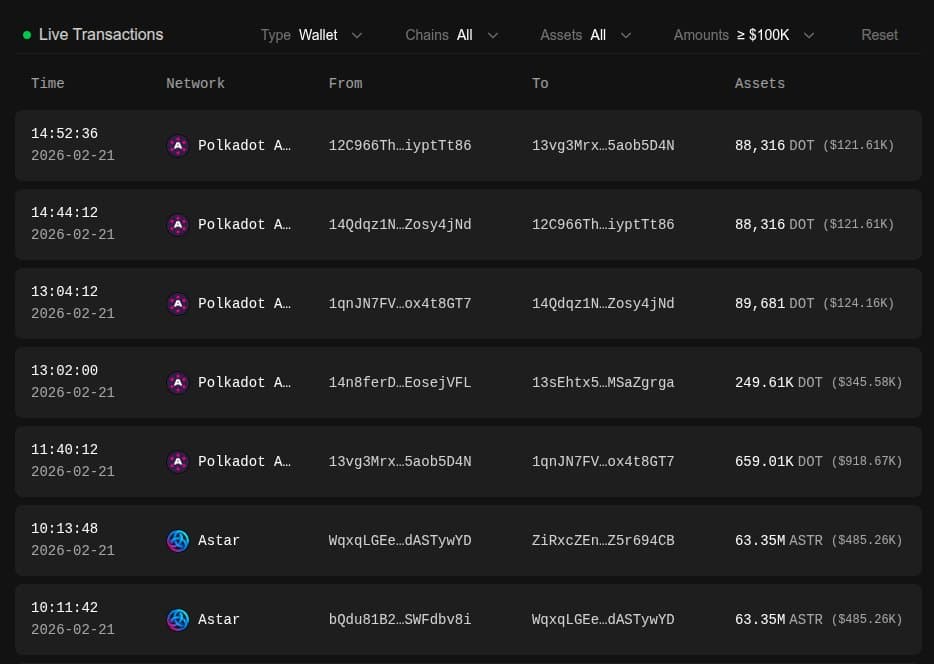
SO/DA Pops the Data Bubble
Perhaps alleviating some of the more creative takes on Polkadot data, SO/DAzone’s XCSCAN now tracks intra-chain asset transfers. This addition completes the full spectrum of internal, parachain, and external movements, offering a definitive view of how value actually flows across the entire ecosystem.
The Core-times are a-Changin
A bygone era of Polkadot is nearing finality. Nova Wallet will discontinue all crowdloan functions following the final round of refunds. Contributions from Bifrost, Neuroweb, Mandala, and Hyperbridge were returned to Asset Hub on February 14th, with Crust being the last to be settled on May 9th.

PBA Equips for the Second Age
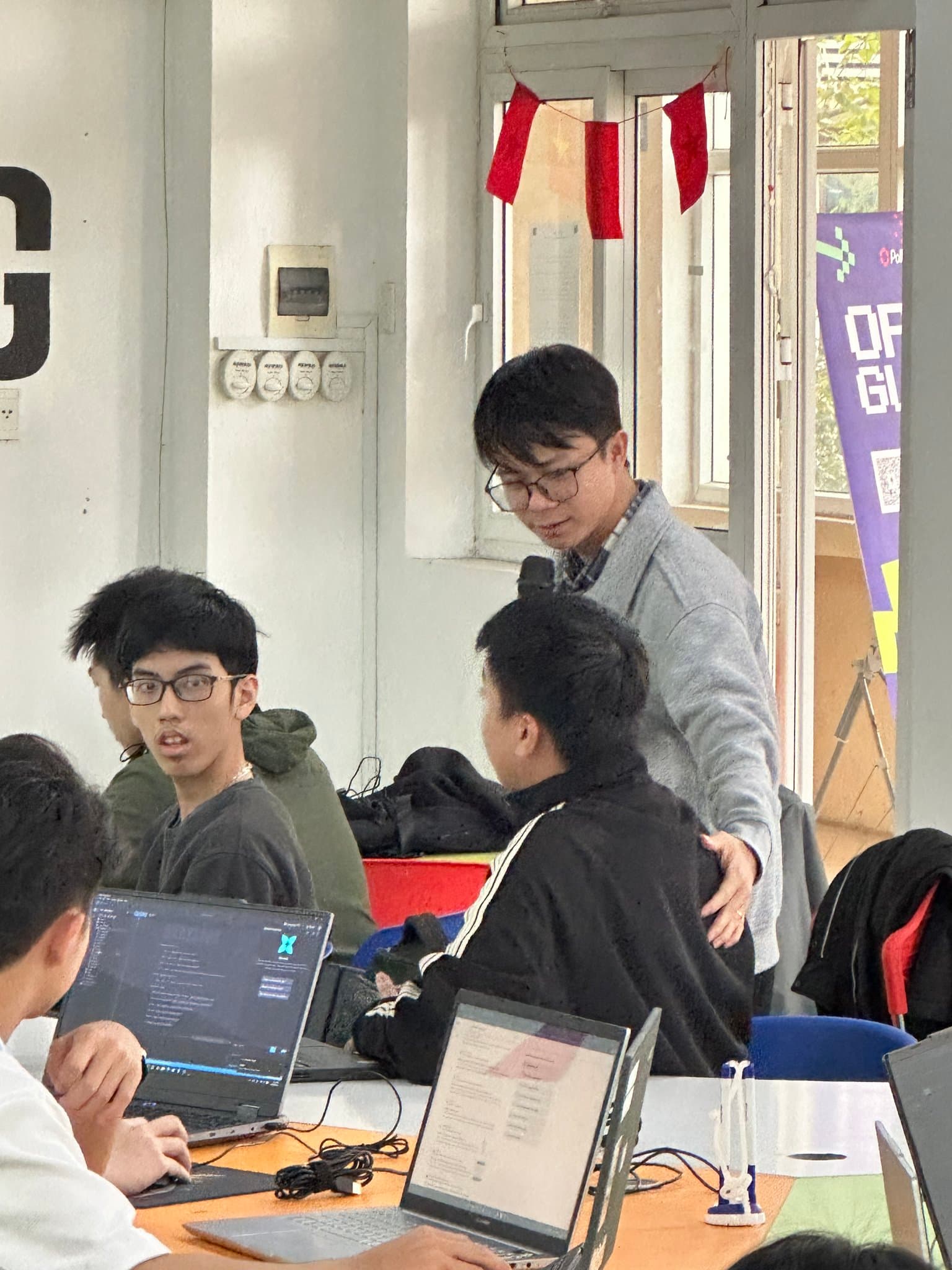
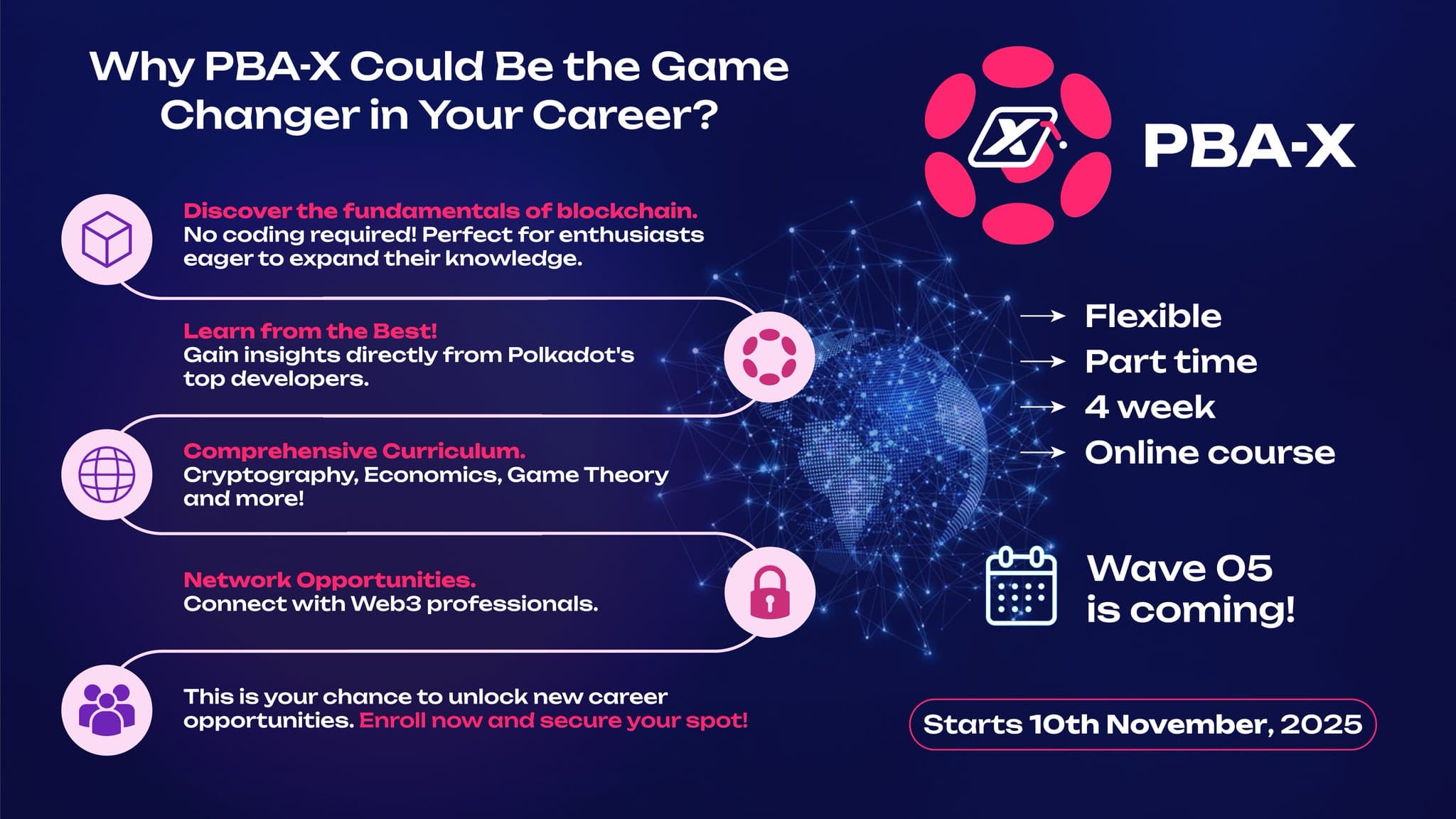
As the protocol enters its second age, the Polkadot Blockchain Academy is shifting focus to support its product-led strategy. Kicking off in Lisbon on April 12th, the Polkadot Builders Program aims to prepare candidates for potential roles at Parity. Level 3 and 4 developers with Rust experience and blockchain knowledge are invited to apply.
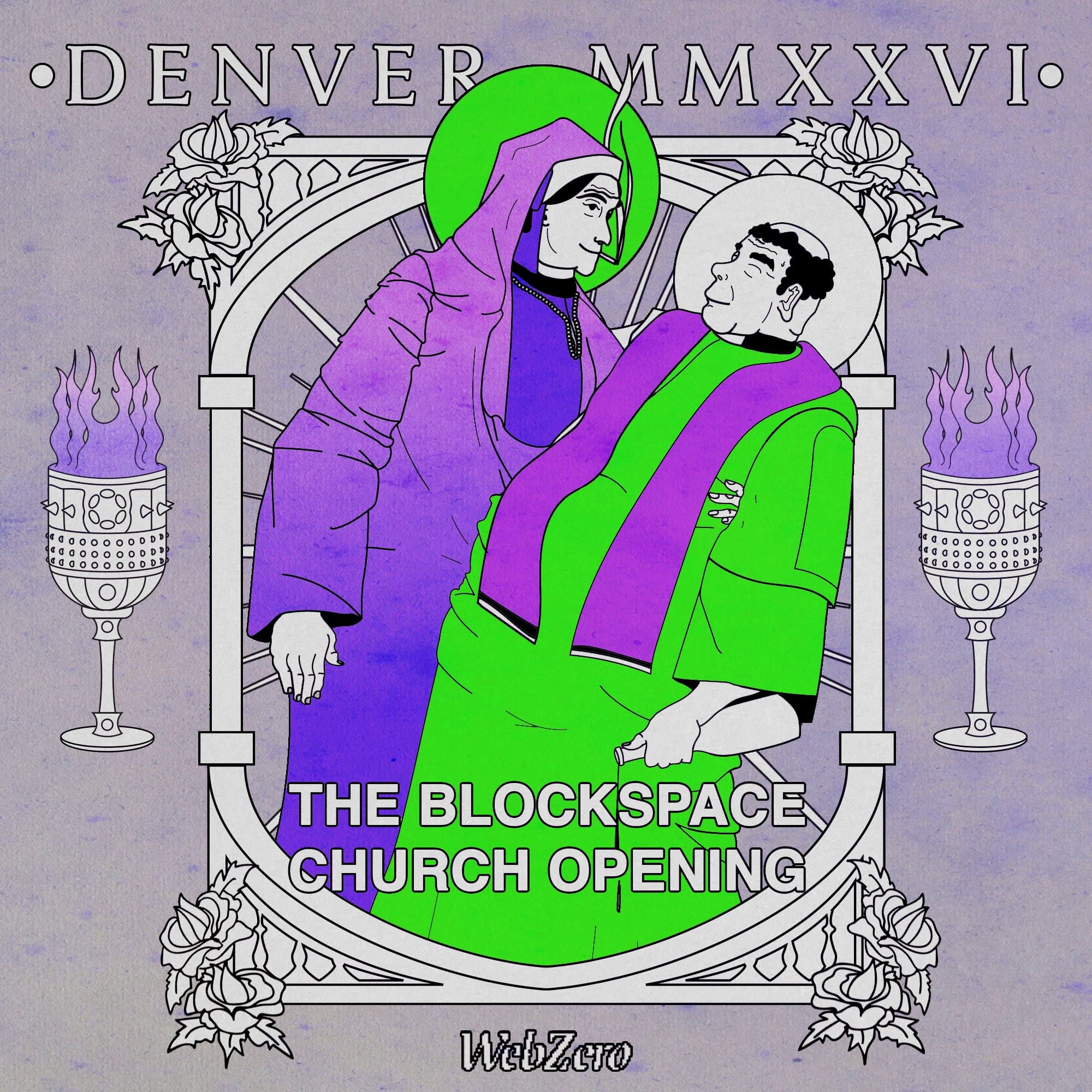
Blockspace Welcomes the Flock
The sanctuary doors have opened for WebZero’s ETHDenver Blockspace Church, supported by Polkadot and Hyperbridge. Inauguration commenced on February 16th with opening cocktails for a curated congregation, featuring an open bar, networking rooms, and a cozy firepit for roasting marshmallows.
Send the BEEFY Back, They Wanted it Well Done
After transitioning to parathread status with on-demand Coretime, the Hyperbridge system triggered an emergency pause. This is because the Polkadot SDK currently lacks BEEFY consensus support for parathreads, which is essential for proof generation. An update is underway and will be Whitelisted on OpenGov shortly.

The Ink May Fade, But Rust Remains
The sun may have set for ink!, but that doesn’t mean the end of Rust-based contracts on Polkadot. Bader Youssef (Web3 Foundation) recently outlined the process using RISC-V on PolkaVM. For the vibe-coders, Erin Grasmick (Parity) offers a Claude skill as an even more accessible route.


Devs Dive Into Dotlake
Parity Data has launched the Dotlake API, giving developers programmatic access to daily and monthly metrics across Polkadot, Kusama, Westend, Paseo, and the parachains. The API provides pre-aggregated data suitable for tasks such as building dashboards, analyzing governance participation, and tracking staking rewards.


Come All Ye DOTful
This year, the ETHDenver Blockspace Mansion gets a holy upgrade, ascending to the grander Blockspace Church to herald Polkadot’s Second Age. From February 16–21, hackers can enjoy all the usual perks, including private chef meals and expertly curated events from the WebZero team.

Bifrost’s Ballot Boost
Delegated Polkadot governance voting is live for Bifrost vDOT token holders. Votes with a conviction between 0.1x and 6x can now be delegated to any address, including the new Bifrost OpenGov vDOT Delegation Track where governance decisions will collectively decided by BNC holders.





What Started with a Blackbird Ends as a Butterfly
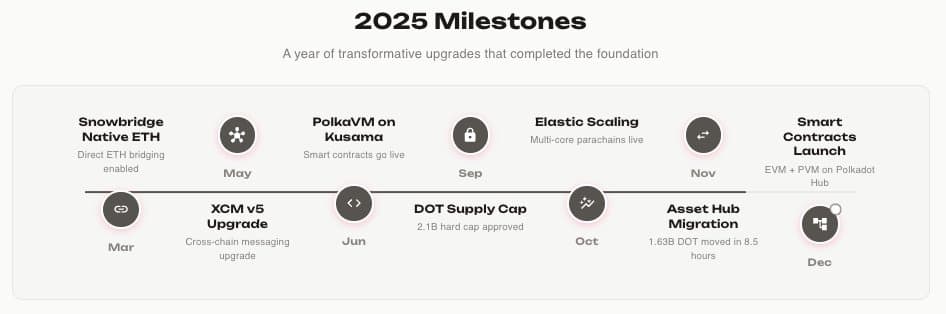
Parity CEO Gavin Wood has published his Polkadot 2025 Roundup, emphasizing at as year of change. Key shifts include his return as CEO, the migration from Relay Chain to Asset Hub, and a new product-led direction for the protocol. Looking ahead to 2026, the focus shifts to mass adoption by ensuring Polkadot’s usefulness and usability extends beyond the crypto-native population.
A Dynamic Wish
Jonas Gehrlein (Web3 Foundation) has initiated Polkadot WFC Referendum 1827, seeking consent to initiate first phase of the Dynamic Allocation Pool roadmap, targeting deployment by March 14th 2026. This phase ends DOT burns, creates a flexible revenue pool for protocol expenses, and reforms validator and nominator parameters.
Multix Waitin’ on a New Year Miracle
Multix, a multisig solution in the Polkadot ecosystem known for its ease of use, is once again at risk of shutting down at year’s end. The project was handed to the PAPI team in November with expected support from the DeFi Infra Bounty, but that funding path has since closed.

One Last Boost for The Kus
It’s the end of an era. After four years of tireless work, 42.7M Youtube views, and 55M X video views, The Kus wrapped its final broadcast with Sunday’s episode of Space Monkeys. As Polkadot enters its next chapter, funding appears to be shifting away from ecosystem communications. Things may be getting a little quieter around here.
Robonomics Reaches for Elastic Potential
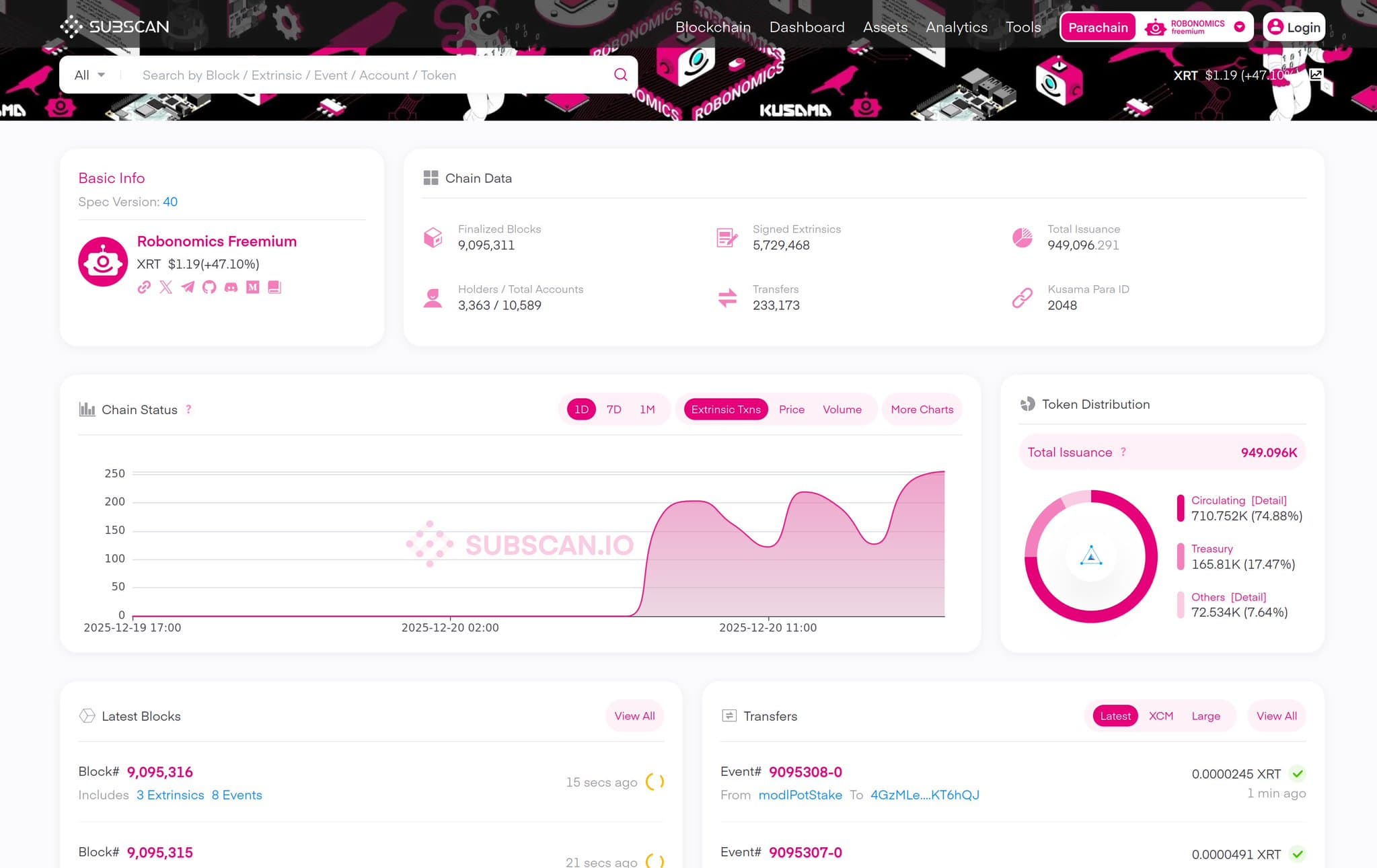
Thanks to a successful referendum and support from Parity, Robonomics Freemium (Kusama) has resumed block production and completed its runtime v4.0.4 upgrade. When v4.0.4 deployment follows on the Polkadot parachain, the team will trial newly unlocked performance enhancements using multiple cores.









A Smoother Path Across the Seas
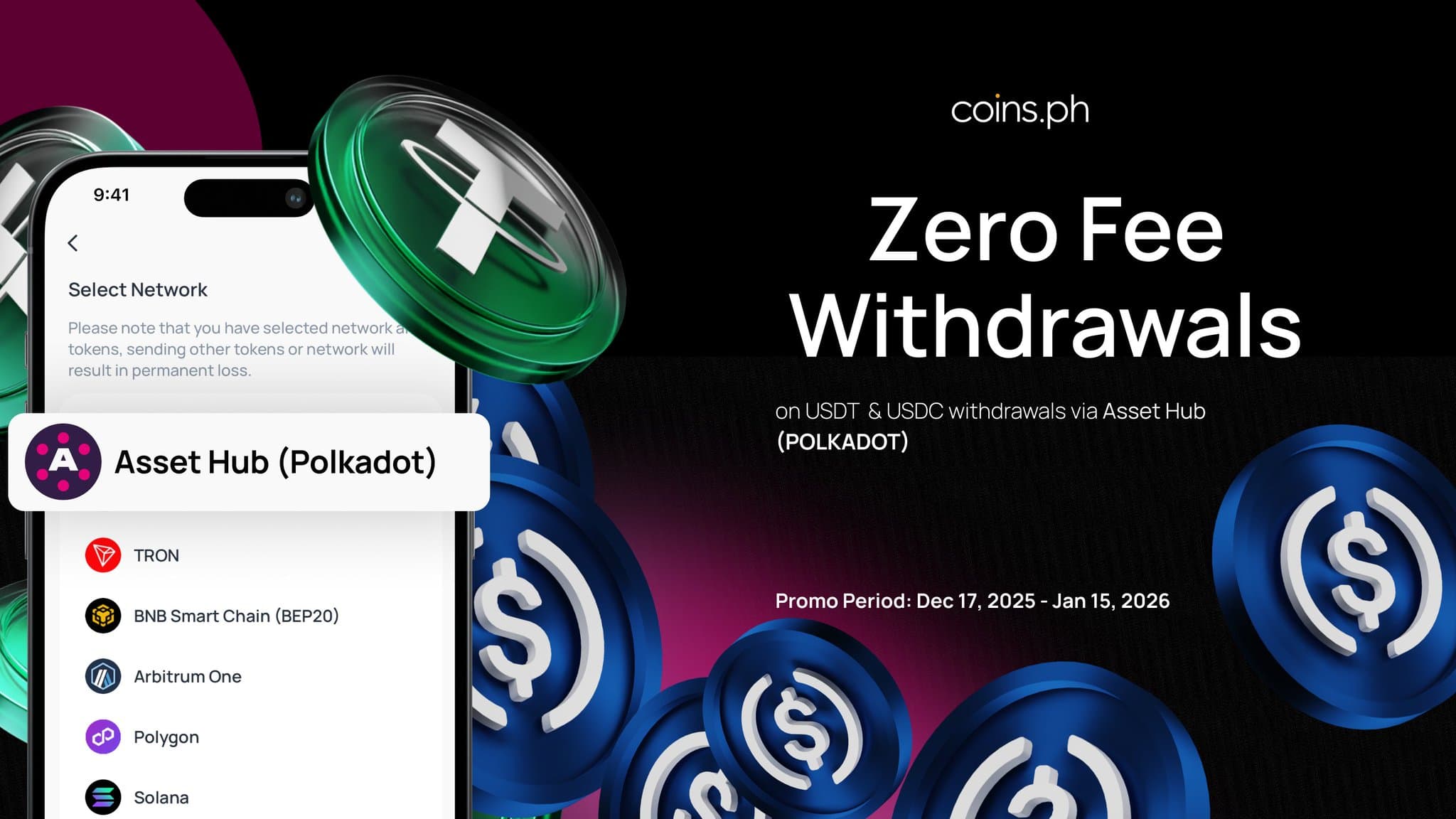
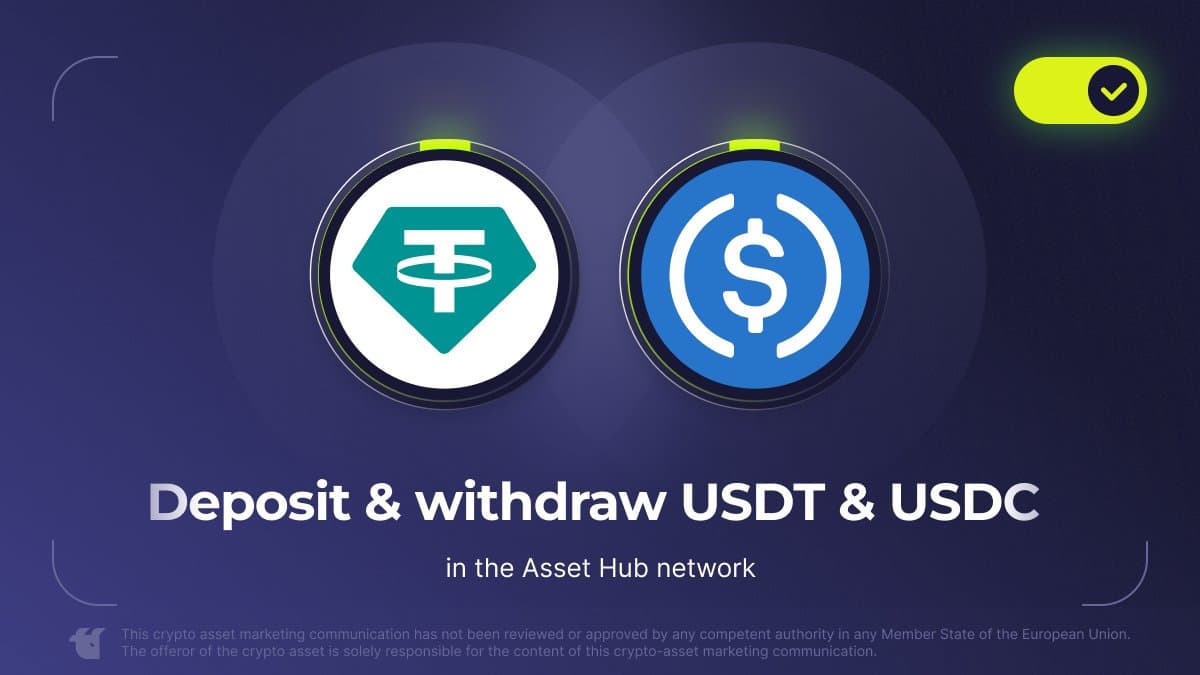
Following the successful integration of Polkadot Asset Hub stablecoins, , a leading Philippine exchange, is launching a major education and adoption initiative. Running through Q2 2026, the program highlights Polkadot as a fast and affordable option for cross-border payments.


Mini App, Mega Moves
JAMTON has launched a Mini-App that connects the Polkadot and TON ecosystems for seamless DeFi, digital assets, and cross-chain trading. The integration eliminates traditional bridge complexity, letting users move liquidity, interact with dApps, and trade across both networks directly from the Telegram interface.

Gav Brings Proof of Video Interaction
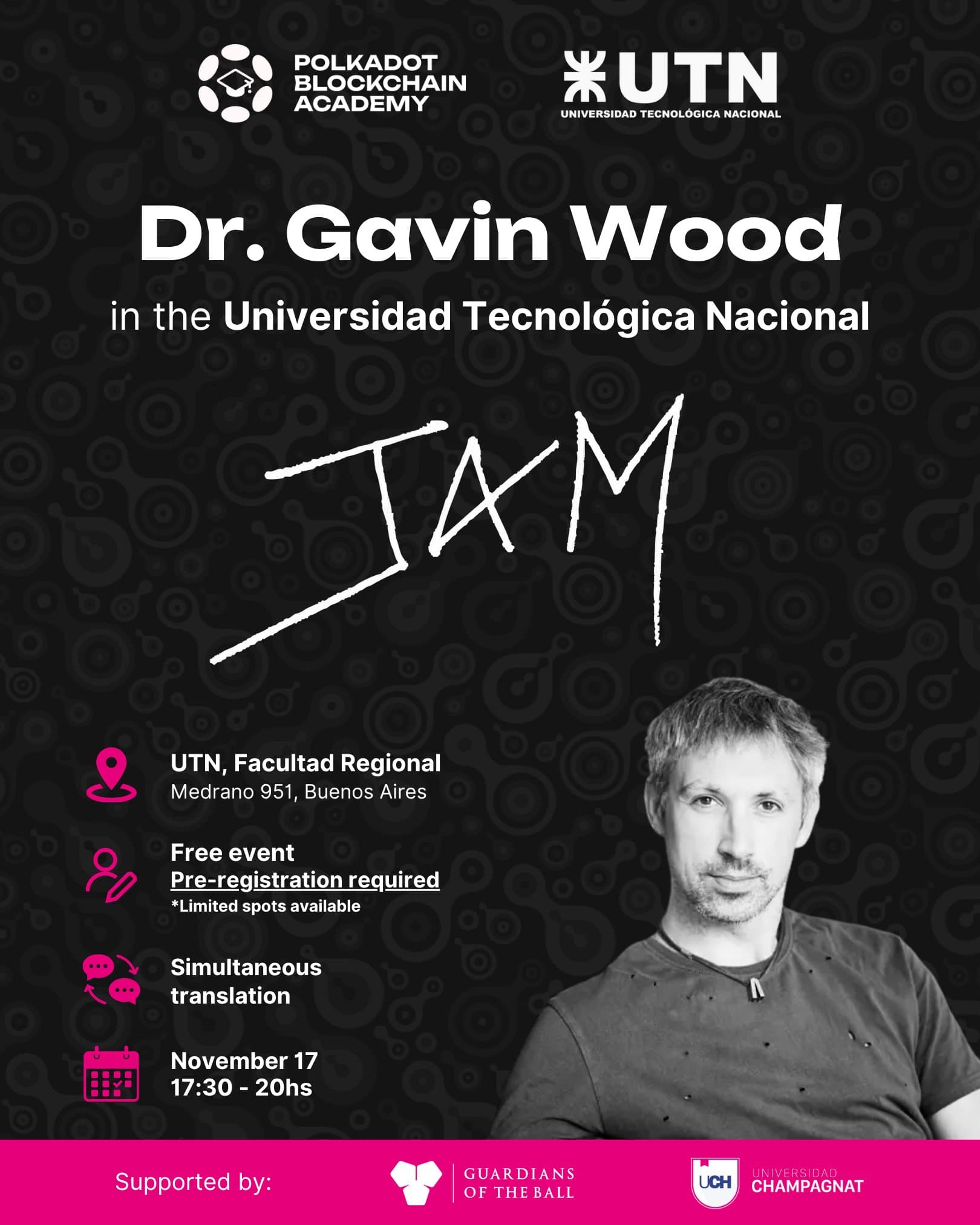
Sub0 Symbiosis kicked off in Buenos Aires on November 14th with Parity CEO Gavin Wood presenting his opening keynote holographically. He outlined Parity’s move from protocol to product building, Project Individuality, and the unified Polkadot web and mobile portals that will onboard millions.
An Unbountiful Pause
The Web3 Foundation Governance Team has initiated Referendum 1791, proposing to wind down the Polkadot Marketing Bounty. This strategic marketing pause aims to preserve the treasury while the community reassesses the best path forward, ensuring that any new program delivers measurable value to the ecosystem.
Proving Personhood Pays Off
Polkadot People Chain has launched Referendum 1783, requesting 3 million HOLLAR to incentivize mass proof-of-personhood onboarding. This funding is split into a one-time bootstrapping grant of $50–$200 for new users, $10 per week for active participants, and large weekly and monthly random prize drops ranging from $250 to $2,500.

DeFi Fab Five Revealed
Velocity Labs has selected five projects for the first cohort of the DeFi Builders Program. Let’s congratulate Joinn (Yield Bearing Wallet/Mastercard), SigilSafe (Estate Planning), WinCoins (Prediction Market), Koni Finance (Multi-chain Trading and Launchpad), and TidalX (Gasless Perps).


Rampin’ Up with Banxa
Banxa has partnered with Polkadot to integrate its regulatory compliant on/off-ramping infrastructure. This provides developers across the ecosystem with ready-to-use payment rails, supporting 100+ payment methods globally and significantly easing the inflow of new liquidity.


The Tree of Wisdom Files Wisely
WisdomTree has filed an application with the SEC to list an ETF benchmarked to the Coindesk 20 Index. This index tracks the performance of twenty of the largest digital assets, including DOT, while specifically excluding stablecoins, memecoins, and privacy tokens.
Runtime Rescue
Polkadot Whitelisted Caller Referendum 1782, now passed, urgently deployed Runtime 2.0.1 to patch a security vulnerability discovered shortly after the Asset Hub Migration. The issue, described in Kian Paimani’s (Parity) post-mortem, was a coding error in the “election-provider-multi-block pallet” that bypassed an origin check, letting any user execute a specific governance-only function.





Doing the Lord’s Work
On October 15th, Polkadot led the Web3 Education, Innovation & Opportunity event at the House of Lords in London. Gavin Wood (Parity), Pauline Vorms (PBA), Richard Houldsworth (Xcavate), and other ecosystem leaders joined British policymakers for a roundtable, gala dinner, and networking.


Armenia Enrols in Web3
On October 9th, Gavin Wood met with the Armenian Minister of High-Tech Industry Mkhitar Hayrapetyan to discuss collaboration on Web3 education, professional development, incubation, and investment. During the meeting, Dr. Wood shared plans to establish a Web3 university in Armenia.


Turning Up the Volume on DV DAO Voices
The Web3 Foundation has made some adjustments to the Decentralized Voices program, increasing DV DAO voting power from 2M to 3M DOT. The goal is to give DVs enough influence to help resolve close calss while still preserving the weight of the broader community vote.


Peers Meet Polkadot at the House of Lords
Xcavate is hosting Web3 Education, Innovation & Opportunity at the House of Lords, London on October 15th. Speakers include Gavin Wood (Parity), Pauline Vorms (PBA), and Richard Houldsworth (Xcavate). Repost and comment on the tweet for a chance to attend this exclusive Polkadot event.

Bill Signs Off as the Dr Gets to W3rk
After more than four years and 1,267 posts of the Polkadot Digest, it’s time for Web3 Foundation Ecosystem VP Bill Laboon to pass the baton. Starting October 13th, Radha Dasari will take the reins and continue sharing daily updates and insights from the Polkadot ecosystem.


Cross-Chain Trails Now in Range
With the support of Velocity Labs, Range has launched Polkadot Explorer, offering analytics and forensic intelligence for the Relay Chain, Asset Hub, Moonbeam, and Hydration. In addition, it monitors cross-chain transactions via XCMP, Snowbridge, Wormhole, Axelar, Hyperlane, and LayerZero.


Limberin’ Up for the Elastic Launch
With the passing of Referenda 1721 and 1736, why aren’t we celebrating the launch of Polkadot 2.0 yet? Parity explains that while Elastic Scaling is now technically live on the Relay Chain, collator and parachain runtimes first need to be upgraded to Polkadot SDK v2509, scheduled for an early-October release.


Aye Aye Cappin’
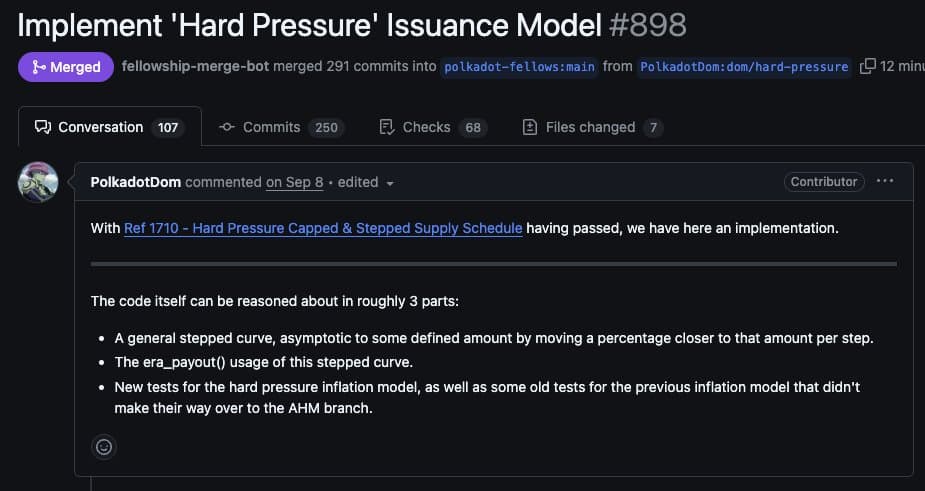
With the passing of Referendum 1710, work will now commence to enact the DOT tokenomic changes requested by the Polkadot community. On March 14th 2026, yearly DOT issuance will be reduced by 53.6%. Subsequent reductions of 13.14% of remaining supply will occur biennially until a cap of 2.1B DOT is reached.
Subwallet’s Development Dues
In Polkadot Referendum 1745, Subwallet is requesting retroactive payment of 795K USDC for development from August 2024 to March 2025. Notable features in this period included unified address format support, swaps between ecosystem parachains, and cross-chain swaps powered by Chainflip.


What if They Both Pass?
Referenda 1728 and 1729 offer two options to continue the treasury acquisition of stablecoins by DCA on Hydration for an additional six months. In addition to 2.64M DOT for DCA, Referendum 1728 proposes adding an additional 1M DOT to the money market via the yield-bearing aDOT token. If passed, these proposals will set up the Rolling DCA feature, meaning that future smaller top-ups can be executed by sending DOT to the proxy account.


Getting Packin’, It’s Almost time to Migrate
In preparation for the Asset Hub Migration, parachains and dApps will need to take some mandatory action. The *transfer_assets* and *(limited_)reserve_transfer_assets* extrinsics still auto-detect the Relay Chain as the reserve, which would lead to failed transactions and potential trapped funds post-migration. This issue has been patched in the latest SDK, so parachains are advised to upgrade before the migration. In addition, parachains will need to be configured to trust Asset Hub as the reserve for DOT. DApps using the incompatible extrinsics will need to switch to alternatives, such as Paraspell SDK, *transfer_assets_using_type_and_then*, or by using XCM with the correct reserve and then passing it to *execute*.


Hackin’ with your Head in the Cloud
The Polkadot Cloud Build Party kicks off on October 6th. Running for 6 weeks, it will feature 3 tracks each with a first-place prize of $3000. Track 1 is Apps that Change the World, where hackers are encouraged to build impactful projects using Polkadot Cloud services. In the second track, hackers will build a chain using the Polkadot SDK or Polkadot Deployment Portal. The third track, Bleeding Edge, is open to all kinds of experimentation, potentially utilizing ZK, XCM, and PVM or other supported smart contracts.


A Model For Easing the Pressure
In collaboration with Tommi Enenkel, Jay Chrawwna has initiated a third WFC referendum for stepped and capped DOT inflation. The Medium Pressure model has a softer initial step, providing additional runway to seek additional revenue sources and build demand for DOT across ecosystem projects.

Showdown at the Cap Step Corral
Jay Chrawwna has initiated two WFC referenda for the community to choose a stepped and capped inflation model. The Hard Pressure model has a cap of 2.1B and a step of 13.14% of remaining supply every two years. Meanwhile, the Soft Pressure model has a cap of 3.14B DOT and a step of 13.14% of the previous period’s issuance every two years. Tommi Enenkel has submitted a competing proposal that diverts a portion of inflation to a buffer fund for Economic Growth Incentives. It has a cap of 2.1B and an inflation reduction of 33% every two years.


Snowfork’s Seeking Stable Ground
Snowfork has submitted Referendum 1695, its third attempt to secure ongoing funding for completed milestones and future Snowbridge development. Taking community feedback onboard, it has now requested the majority of funds (2.44M USDC) in stablecoins. An additional, cancellable payment of 116K DOT would be payable in August 2026 on successful completion of future milestones.


Hub Yourself a REVyMerry Christmas
Following input from core teams and ecosystem contributors, a decision has been made to prioritize attracting existing third-party providers to Polkadot Hub to facilitate the porting of top Ethereum dapps and enhance functionality for Polkadot rollups. As PVM does not offer full compatibility with many of these providers, the Parity team is strategically prioritizing delivery of a 100% EVM compatible solution with support for legacy Solidity versions by mid-December. For this, they have chosen REVM, a fast, well-maintained, and frequently audited Ethereum implementation trusted by major projects like Foundry, Hardhat, and Optimism.

DOT Hard Cap Gets Hard Support
With the conclusion of the RFP #1 study on capped DOT supply and stepped inflation, three models have been presented to the DAO and are up for a non-binding vote on OpenSquare. The Hard Pressure model, which has so far received overwhelming support, proposes to halve DOT issuance every two years with a total supply cap of 2.1B DOT.


Q2 Treasury Report DeFi-ned by Incentives
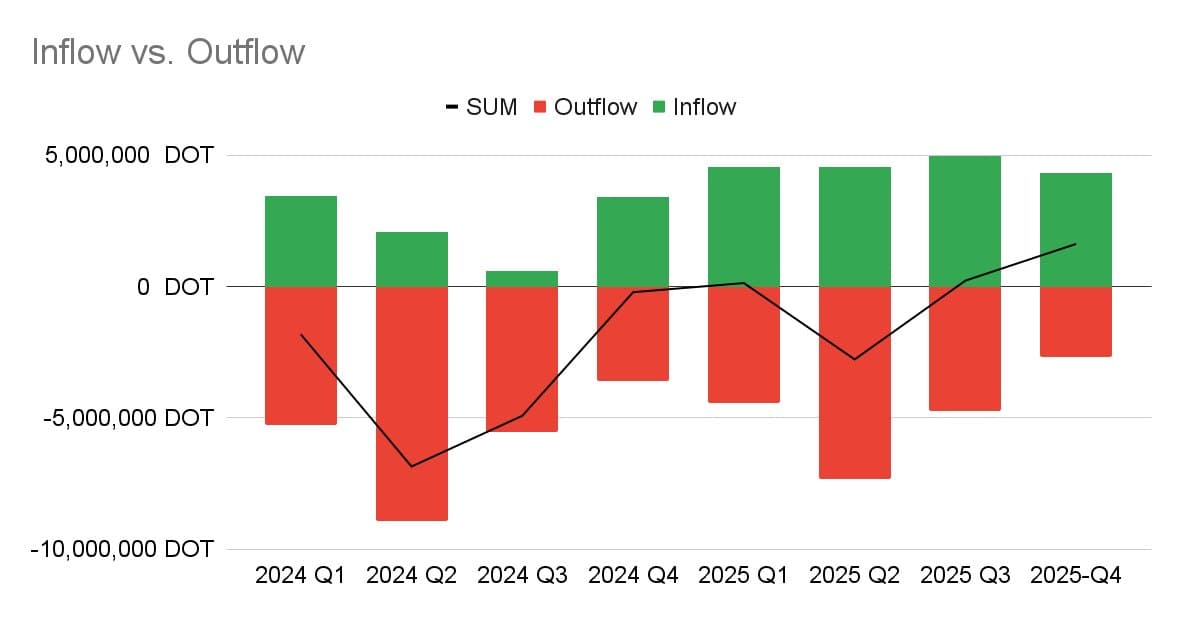
Tommi Enenkel has released the Q2 2025 Polkadot Treasury Report. Economy was the largest spend category, with DeFi incentives accounting for a third of all expenditures. Despite a net loss of 2.7M DOT, the treasury’s current balance of 31.1M DOT supports a stable long-term outlook.
Bringing the Chill to Buenos Aires
In Polkadot Referendum 1684, Webzero is requesting 739K USDC to fund Sub0 2025 conference and hackathon in Buenos Aires Argentina. Planned to coincide with the Devconnect conference, the team has a 20 room neo-brutalist venue, and is anticipating 3000 guests over 3 days. They plan to use the event to shine a spotlight on Polkadot Hub smart-contracts, JAM, and Polkadot’s resilient infrastructure.

Harbouring Big Ideas for Polkadot Startups
Polkadot hosted Harbour Industrial Capital (HIC) and members of its advisory board on July 22nd for a discussion on ecosystem startup investment. The session featured Mario and Max (HIC), Michael and Pakman (Mandala Chain), Xiaojie (Polkaworld), Pauline (PBA), Tommi (OpenGov Watch), and Angela (DOT Play).


Polkadot Staking Update Throws Wallets a Curve
A recent change to Polkadot staking, where token locks are now holds has caused an issue on Ledger Live and Trust Wallet where balances are incorrectly displayed. Until this issue has been rectified, affected users are encouraged to use an alternative wallet or block explorer to check their balances.


Polkadot Africa Banks on Builders
In Polkadot Referendum 1672, Polkadot Africa is seeking 352K USDC to fund an additional year of builder and community growth in Africa. Over the next year it is planning to conduct numerous developer workshops, bootcamps, and hackathons, while furthering community engagement.


Node to Joy
The Web3 Foundation is now accepting applications for the third cohort of the Decentralized Nodes program. Selected nodes will be nominated for a four-month term, enhancing their recognition and earnings. This program aims to enhance decentralization in Polkadot and Kusama by promoting node diversity in location, provider, and hardware.


Harbouring the Best Minds in Polkadot
Harbour Industrial Capital has welcomed a new funding advisory board to guide allocation of the HIC Funds. Let’s welcome Angie Dalton (Dot Play), Pakman (Kylix/Mandala), Tommi Enenkel (), Xiaojie Pang (Polkaworld), Pauline Cohen Vorms (Polkadot Blockchain Academy), and Michael Bennallack (Mandala).


Zero-ing in on the Polkadot Ecosystem
Zerohash, a leading platform for crypto and stablecoin infrastructure, has integrated Polkadot and now supports DOT, USDT, and USDC Asset Hub. Zerohash will streamline the process for platforms to launch on-chain products and tokens in the Polkadot ecosystem, by managing essential blockchain infrastructure and regulatory licensing.
Kick Out the DOTs and Pump Up the JAM
Colorful Notion has initiated a Polkadot Wish for Change proposal to rename the DOT token to JAM by the end of 2026. It argues that DOT will always be too closely linked to securing parachains, and that the rebranding to JAM will help reframe the network’s evolution as a trustless supercomputing protocol.
They Could’ve Called it Solkadot
The JamZig team has successfully executed Solana smart contracts in its Zig implementation of JAM. This successful proof-of-concept leads the way for the Polana Network project, which aims enhance Solana compatible development possibilities with the parallel processing power of JAM.

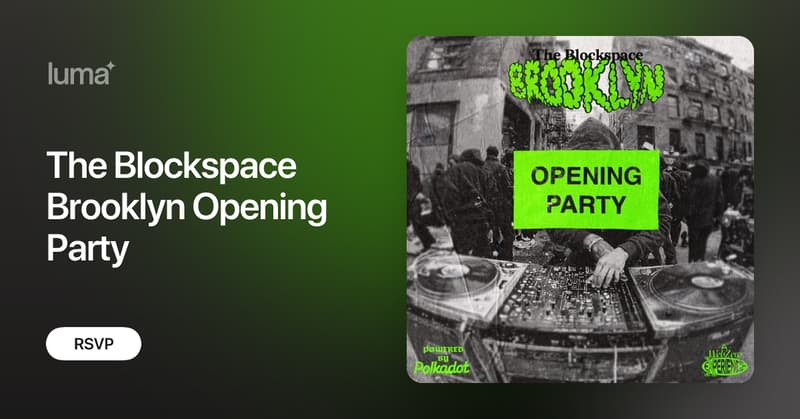
Pink Bussin’ in Brooklyn
From Berlin to Brooklyn, WebZero’s Blockspace is back, this time to complement Permissionless and NFT NYC. It all kicks off on Monday June 23rd, with the Blockspace Brooklyn Opening Party, featuring DJs, free-flowing drinks, catering, and the return of the Polkadot Pink Bus. On the eve of Wednesday 25th, Ready Player DOT will feature Mythical, DOT Play, and Heroic followed by a Pudgy Penguins after-party. The Blockspace co-working space will be open day and night all week, with meals served by the resident private chef.

Ref #98 Waters Down Delays
Hydration Referendum 98, if passed, will request the Technical Committee to whitelist all referenda related to the GIGAHydration campaign. With Polkadot Treasury funds hitting the Hydration wallet on June 26th, this will help to expedite the launch of incentives on June 27th.


Thanks SEC, I Guess We’ll See You Next Month
A decision on the NASDAQ listing of the Grayscale Polkadot Trust (DOT) has been delayed as the SEC seeks further comments and rebuttals. Interested parties have 21 days to comment on how the trust will prevent fraud and manipulation. A further 14 days will be allowed for the submission of rebuttals.
Wishing for Change is Free. A Non-custodial Polkadot Visa Card? Priceless
Polkadot Wish for Change Referendum 1608 seeks the Polkadot DAO’s approval to initiate the rollout of the non-custodial Polkadot Visa Debit Card. All integration costs would be covered by Referendum 1573 which is funding Polkadot App related expenses for the next six months.




Bridging Funds and Funding Bridges
In Big Spender referendum 1587 Snowfork is requesting a $5M USD equivalent in vested payments for completed milestones and 12 months of operational costs of Snowbridge. The payments allocated to operational costs and team incentives ($3.75M) will be held in the Insurance and Bug Bounty Coverage wallet, vested over 12 months. Funds may be diverted to reward identifiers of vulnerabilities, or compensate victims of a bridge exploit.
Bounty Requests a DOT More
In Treasurer Referendum 1584, the Marketing Bounty is seeking a top-up of 1.2M DOT to cover expenditure for the next six months. The team are onboarding two new curators. Mark Cachia (Scytale) will guide investment strategy, while Sergi Mata (Magenta Labs) will take on a business development role.


Give the Proposal a Fair App-raisal
Polkadot OpenGov Big Spender Referendum 1573 seeks 1.03M USDT for 6 months of ongoing development of the Polkadot App. Funds would cover software development, marketing personnel, tooling and legal costs, with additional costs falling under the scope of Web3 Foundation funding and the Marketing Bounty.

The Baron’s Makin’ Deals on the Gray Market
With the potential cost for purchase and subsequent renewal starting at 920 DOT in the next Coretime Sales round, the Baron has cut their first deal for a Polkadot core. ParaID 3415 has purchased a core for 2000 DOT, securing a renewal price of 95 DOT, rising by 3% each period.

A Disk-stressing Storm
Between May 2nd and 7th, Polkadot parachain block times experienced a period of degradation. Andrei Sandu (Parity) has published a post-mortem. The cause of the issue related to disputes originating from a single validator suffering from disk failures. In each new session the faulty validator was added to the list of disabled validators after losing a dispute. Due to a bug, the list of disabled validators clears when a validator restarts. Thus, any restarted validator would join disputes raised by the faulty validator, triggering a dispute storm. The issues have been patched in the stable2503-4 release.

New Inflation Model Inflates the Coffers
Tommi Enenkel has published the 2025 Q1 Polkadot Treasury Report, recording the first ever quarterly net profit. The top spending category was outreach (7.5m USD), followed by software development (1.5m DOT), and operations relating to network infrastructure (2.1m USD). With the treasury inflows, under the new inflation model, current spending is sustainable for at least 10 years.


Buy from the Baron, If You Dare
The Coretime Baron is offering to sell 11 Polkadot cores at negotiable prices. Projects have a chance to secure a slot at a lower price than next Coretime Sales cycle, which has a starting price of 920 DOT. Kusama cores are also available, but will be sold in parachain bundles of 12 for a price in the region of 800 KSM.

Code and Conquer in Canada
Presented by Webzero and Polkadot, the Blockspace Hacker House for Consensus Toronto runs from May 13th to 16th. Hackers will be competing for a Polkadot bounty prize pool of $20K. The co-working space is open every day from 10am, with an on-site private chef, and open-bar from 5pm.

Baronial Core-uption
In Coretime Sale #9, the Baron has renewed all nine of their cores for 9.2DOT. In addition, they've snapped up the two available cores on the open market at the starting price of 92.2 DOT. As a result, the starting price for Coretime Sale #10 will be in the region of 900 DOT.
Let’s Get Messi in Argentina
Webzero has initiated a discussion on the Polkadot forum for their ambitious plan to host Sub0: Symbiosis 2025, a new flagship event that would merge Sub0 and Decoded. They are proposing to hold it in Buenos Aires, Argentina on November 14th immediately before the DevConnect conference. The Bubble, a 20 room neo-brutalist venue, has already been secured. With a treasury proposal expected soon, now is the time to join the conversation and help shape the future of Polkadot events.

With the Egg Barely Heated, the Phoenix is Yet to Hatch
Incubation Phase I of the Polkadot Ambassador Fellowship has wrapped, and Lucy Coulden has published the final report, detailing highlights, initiatives, and strategic gaps. With the Ambassador Fellowship Advisory Board stepping down and returning excess funds to the treasury, stay tuned for updates on the next phase of funding and growth.
A Million Dollar Alt Account
Quadrivium is requesting 982K USDT for milestone 4 for of its Kagome C++ implementation of the Polkadot Host which recently became the first alternative client implementation to enter the Polkadot validator set. Funding would cover both retroactive and upcoming updates and audits.


Securing Strategic Success in Spain (and Andorra)
Iberlabs, the Polkadot BD Team for Spain and Andorra, is seeking 144.52K USDT to fund twelve months of continued operations. In that time it hopes to secure at least 2 government or enterprise integrations, collaborate more deeply with its strategic partners, attend and speak at key events, and convert numerous leads already generated in early 2025.

Polkadot Gets Easy A’s at Harvard
Let’s congratulate our winners from New and Existing project streams of the Easy-A Harvard Polkadot Hackathon. First-place winners ($5K) were Mosh, a decentralized ticketing platform, and Tippin’ Dots, a social-media tipping protocol that utilizes verified DIDs. In second place ($3K), a platform for decentralized gambling called Scratch-off, and PolkaFarm, a yield-farming dApp for Polkadot Asset Hub. Third place ($1K) went to EscroDot, which facilitates escrow payments for AI agent services, and MergeDot, a platform for incentivizing open-source development contributors.

A Little Bit of ReHydration
In Polkadot Referendum 1542 Hydration requests 5M DOT for liquidity incentives over a 12-month period. To capitalize on increased demand in the DeFI space, stablecoins USDC, USDT, and HOLLAR would receive 2M DOT of incentives. To attract more liquidity from outside of the ecosystem, 2M DOT would go towards incentivizing high-volume Snowbridge assets, such as ETH and tBTC. Finally, to continue the traction built with its launch, 1M DOT would be allocated to incentivize GIGADOT.


Don’t Forget to Renew Your Coretime
In the latest round of Coretime sales, Mythos and Xcavate did not purchase their slot leases during the renewal period. Subsequently, a rogue activist, seeking numerous changes to the way Coretime sales are handled, bought all available cores on the free market. Without intervention, Mythos and Xcavate will soon be unable to produce blocks. Bastian Kocher (Parity) has initiated Whitelisted Caller Referendum 1536 to open and assign cores to Mythos and Xcavate for a period of approximately two months. In the meantime, Basti has opened RFC-142 to discuss potential solutions to balance the current market dynamics and prevent future exploitation.

Anarchistic Voice Activated Real-Estate Funding
The winners of the Easy-A London Hackathon Polkadot Existing Projects Track also shared a prize pool of $9K. In third place ($1K) was Echopay, a voice-activated app for sending and signing transactions. Paxmata, a non-commercial real-estate project management and funding platform got second place ($3K). First prize ($5K) went to Anarchy Build, an AI community innovation hub where creators can build in public, monetize their work, and earn engagement-based rewards.

Forensically Farming Shipping Slots
A prize pool of $9K was shared between the Easy-A London Hackathon winners in the Polkadot New Projects track. Third place ($1K) went to Astartes, a forensic grade logging system, while LiquiDot, an automated yield-farmer took second place ($3K). In first place ($5K) was Polkaship, a marketplace for trading and hedging of freight shipping slots.

PoKe-ing the Treasury to Buy a Little More Time
The PoKe BD team, originally funded by a Decentralized Futures grant, has requested 290K USDT from the Polkadot Treasury for six months of continued operations. Agreements have been signed for opportunities spanning multiple continents and verticals such as government, healthcare, energy, and defense are in advanced stages of negotiation. To take these projects forward, the BD team has expressed that 6 months of key accounting and project management would be necessary. The requested amount would cover salaries, travel, legal, and accounting expenses.


A Yappin’ KOL-lateral Adjustment
With month one of the Polkadot Yaps campaign wrapped and rewards distributed, the Marketing Bounty has announced some adjustments to the reward spread. Taking community feedback on board, rewards will be distributed more evenly while maintaining an attractive bonus in the highest tiers to continue attracting influential outsiders.


Bifrost: loan for more vDOT in Polkadot.
After successfully repaying previous loans, Bifrost is requesting a new loan of 500,000 DOT at an interest rate of 7%. This loan will be repaid over one year, using staking rewards. The goal is to strengthen DOT-vDOT liquidity and to stimulate vDOT adoption across Polkadot's ecosystem DeFi.

Parity Technologies: The scope of Polkadot's actions is expanding more and more.
Parity Technologies announces the gradual rollout of EVM-compatible smart contracts on Polkadot. This initiative aims to encourage developers and projects built on Ethereum to leverage Polkadot’s strengths to build high-performance applications.


PBA: 4 Watch Panels not to be missed.
Get ready for a series of four watch panels on the Polkadot ecosystem, hosted by Polkadot Blockchain Academy for the following program: - April 7 (5:30 PM CET) Polkadot Governance. - April 8 (9:45 AM CET) Web3 Regulation and Challenges. - April 8 (5:30 PM CET) Gaming on Polkadot. - April 9 (5:30 PM CET) Jam with builders.


Polkadot: lending and borrowing coming soon.
Kylix Finance is on the verge of becoming fully operational, facilitating secure cross-chain lending and borrowing within Polkadot. Phase 3 has been validated by the Web3 Foundation, strengthening the protocol's reliability and improving interoperability via the XCM protocol. Phase 4, the final stage of development, is almost complete and focuses on the necessary technical adjustments to optimize the user experience, security, and scalability of the platform.

Why Did W3F Do This?
The Web3 Foundation has announced the fourth cohort of Web3 Foundation Decentralized Voices delegates. Six delegations will receive voting power of 5M DOT on Polkadot and 30K KSM for a four-month term starting on April 14th. Notably absent are three-time delegates Saxemberg and ChaosDAO, as the foundation selected this cohort with a preference for candidates that haven’t been nominated multiple times before. The delegates for cohort 4 are: Hungarian Polkadot DAO JAM Implementers DAO KusDAO PermanenceDAO Polkaworld Trustless Core
A Stable Proposition
Polkadot OpenGov Referendum 1501 proposes to renew treasury acquisitions of USDT and USDC. If passed, 5M of treasury DOT will be DCA’d into stables over a period of 12 months. Idle DOT will be converted into aDOT and supplied to the lending market on Hydration, offering the benefits of additional yield while also contributing substantially to DeFi liquidity, metrics, and use-cases.


Thank You, Nex
On March 19th and 20th, the Nexblock conference in Poland featured presentations by Radhakrishna Dasari (Web3 Foundation), Christopher Kampitsch (Scytale), Ben McMahon (Hydration), and Thomas Riviere (Bifrost). Meanwhile, the Polkadot featured Gavun Wud, and our very own Emil Kietzman.


DOT now on InvArch.
Following InvArch's recent launch of its DAO management portal, bootstrapping DAO treasuries has become much easier. With the introduction of DOT and Polkadot Asset Hub native stablecoins, you can now manage your DAO more effectively across the Polkadot ecosystem and beyond (in the future)


Polkadot UX bounty: UX Audit grants.
The Polkadot UX bounty invites Polkadot DApps to apply for UX audit grants program. 7 DApps will be selected to start, and the selection criteria are: Have an MVP or live product, be a Polkadot parachain, be an Open Source project, provide all information about previous funding, show a strong commitment to Polkadot by displaying it for example and commit to implementing the recommendations after the UX audit.


Authentically Verified, and Secured by Polkadot
Vbrick, a leading end-to-end enterprise video solution provider, in collaboration with Blockdeep Labs, has announced its plans to launch Verified Authentic, a video content ownership verification framework, on Polkadot. The first operational phase is expected to launch in summer 2025.





Nova’s In Da House
Wednesday 26th February 2024 20:30 GMT -7 Blockspace Mansion ETHDenver With free-flowing drinks, food prepared by a private chef, and a high chance of bumping in to the one and only Leemo, you’d better get yourself over the the WebZero Blockspace Mansion after ETHDenver on Wednesday night for the Nova Wallet House Party.
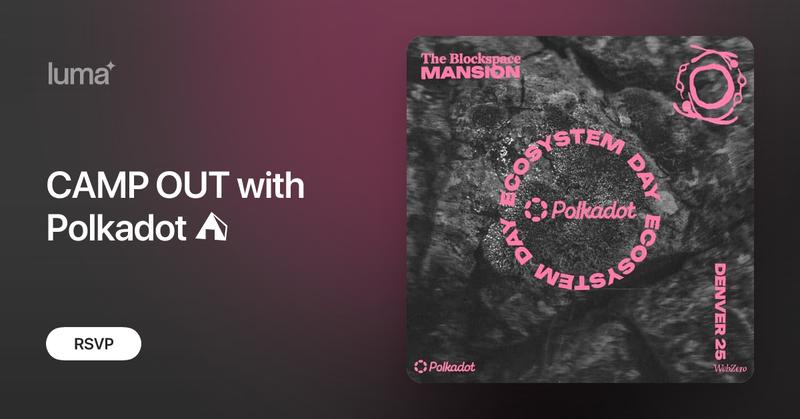
Polkadot’s Pitchin’ Tents
Wednesday 26th February 2024 14:00 GMT-7 Blockspace Mansion ETHDenver Polkadot and WebZero present Camp Out with Polkadot featuring speakers Vitaly Butalov (Robonomics), QEDK (Avail), Kevin Neilson (Moonbeam), Lucas Moskau (Evrloot), and Shawn Tabrizi (Polkadot Fellow).
Polkadot v1.4.0 upgrade
The referendum for Polkadot version 1.4.0 upgrade was approved by the community, this upgrade will improve several things in the Polkadot network. The main one being: to allow assets in a pool to use special payment and to improve how bridges work by adding support for Ether. It will roll out on February 26 this year.



Polkadot Partners with Mindevolved.
Polkadex has announced a strategic partnership with Mindevolved, an AI-driven software engineering studio with a proven track record in the crypto space.Mindevolved will develop and deploy Polkadex's order book, enhancing the platform's performance and scalability.
Blockchain course launched for UK policymakers by polkadot
To help policymakers make informed decisions on Web3/blockchain adoption and crypto regulation, Polkadot is preparing to launch a blockchain technology course. UK lawmakers will be the first to participate through the Polkadot Blockchain Academy
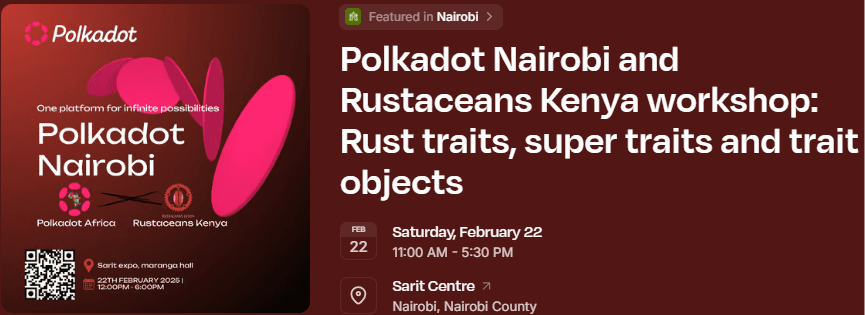


Achieving a bit of Consensus on the Side
On Tuesday February 18th, Polkaport East and SNZ Holdings are hosting the official Polkadot ecosystem side-event for Consensus Hong Kong. It will feature keynotes from Tommi Enenkel () and Ziga Drev (Origin Trail), along with panels on institutional adoption and building on Polkadot in Asia.


The Jam before the JAM
Monday February 17th 12:00 GMT +8 Cyber Arena, Cyberport Mall Hong Kong Pala Labs presents a JAM tour warm-up event with keynotes by Alice und Bob () and Zhou (PaperMoon), along with a panel featuring Dixon (OneBlock+), Patricia (OpenGuild), Phil (EasyA), Victor (Bifrost), and Kristen (Polkaworld).



Network and Achieve a General Consensus
PolkaPort East in collaboration with 852Web3 is hosting a special Consensus edition of the Polkadot Monthly Meetup on February 11th in Hong Kong. It will be an informal event, without speeches, for networking and drinks with builders, investors, and enthusiasts.


Something to Treasure
The Polkadot Treasury Report for 2024 has been published, and things are looking a little less dire than indicated in 2024 H1. While spending for the year totalled a sizable 133M USD, the treasury now has a balance sheet of 210M USD and the theoretical “runway” has been extended from two years to ten years.


Vive Le DOT
Lead sponsor Polkadot made a strong impression at the CryptoXR conference in Auxerre, France. DonDiegoSanchez opened with his speech Non, Polkadot n’est pas mort!, while the LeNexus team manned the Polkadotstand, connecting with developers and curious new arrivals. Attendees were invited to download their first Polkadot wallet, mint a special edition TOD NFT, complete Airlyft tasks for merch, and compete for prizes in Pinkonomic Racing.



ETH Won’t Need to Wear that Wrapper Anymore
Polkadot OpenGov Whitelisted Caller Referendum 1400 is open for voting. If passed it will lower the cost of Snowbridge transfers from Polkadot to Ethereum from ~6.12 DOT to ~1.49 DOT. In addition, it will register native ETH on Asset Hub and make it a sufficient asset with a minimum balance of 15k Gwei.


Doing the Lord’s Work
Lolmcschizz has initiated a discussion on Kusama OpenGov proposing that 33,333 KSM from the treasury be added to the Hydration Omnipool. This move aims to address the longstanding issue of KSM liquidity throughout the Polkadot ecosystem, which has forced many to resort to centralized solutions.






DelaWEN in Delaware
Something may be brewing in the US with 21Shares, a Swiss provider of crypto-currency exchange-traded products. The discovery of an entity named 21SHARES POLKADOT TRUST listed in Delaware, as reported by CryptoSlate, is fuelling speculation about a potential US DOT ETF application.

What A Wonderful Year for Polkadot
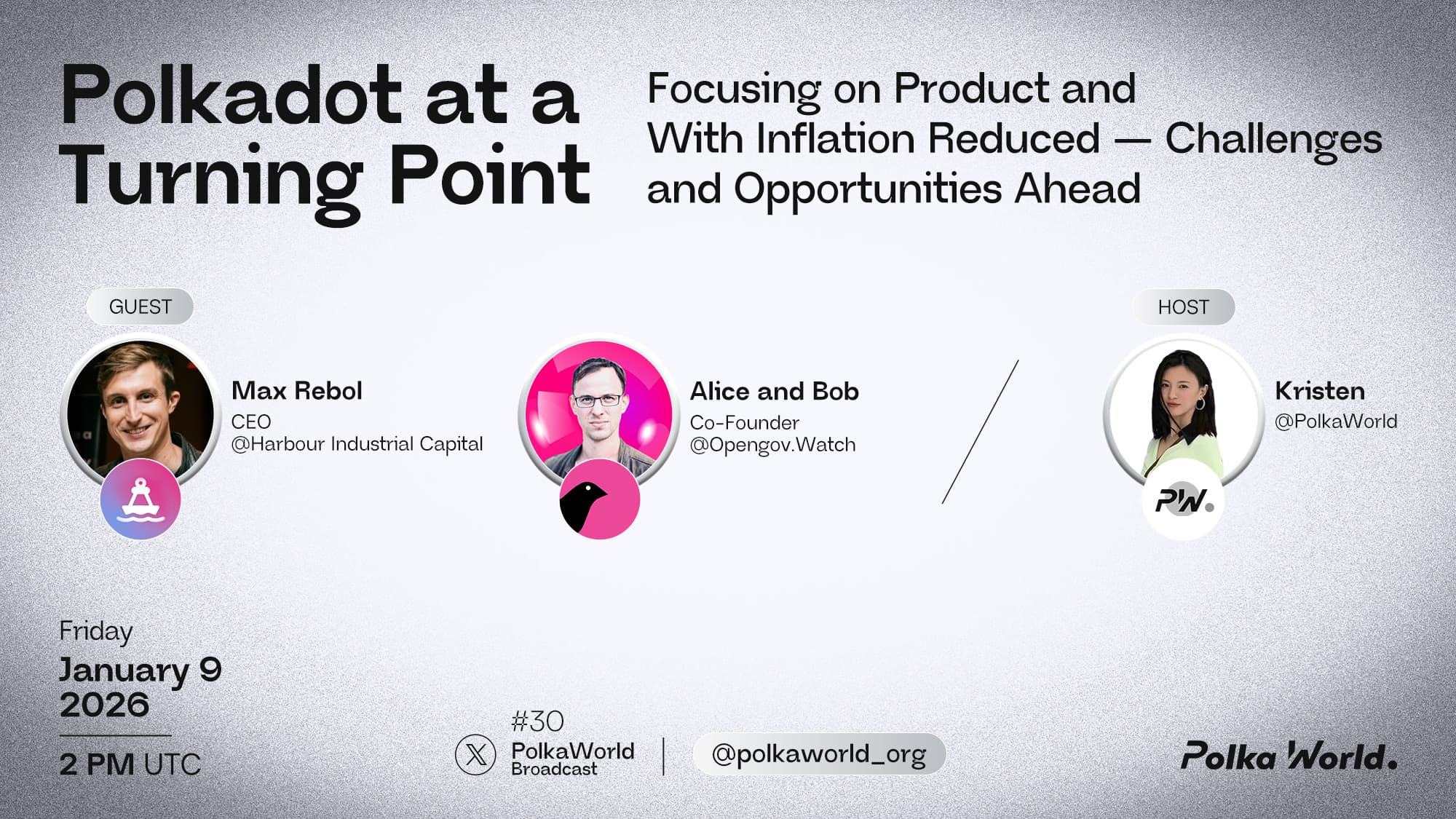
Polkaworld hosted the Polkadot 2024 Year-End Recap on Friday December 20th. It featured an all-star lineup which included Max (Harbour Industrial Capital), Tyrone (Bifrost), Seun (Hyperbridge), Alexis (Gavun Wud), Lolmcschizz (Hydration), Tracy (OneBlock+), Fillippo (Web3 Foundation), and David (Polimec).






Turtle Updates at Hare-speed
Velocity Labs releases v2.0 of their Turtle bridging DApp. Turtle now supports one-click token bridging from Ethereum to Hydration, Bifrost, Moonbeam, and Mythos. Thanks to an integration of Paraspell’s XCM SDK, cross-chain support between popular Polkadot parachains has also begun rolling out.






Let's pass the mic to Web3 educators
12th December 14:00 UTC Polkadot Socials On this episode of Decentralized Mic, Zoe MC (Polkadot contributor) hosts Kwok Phil (CEO & Co-Founder EasyA), Dom Kwok (COO & Co-Founder EasyA), Pauline Vorms (CEO & Co-Founder PBA Academy), Tim Dobie (Dir. Student Engagement, Selection & Post PBA Experience) and Ian Brunner (CEO & Co-Founder | IPTS - Interplanetary Talent Services) to talk a out Web3 Education and aonboarding.




Does Michiko Still Attend These Things?
Thursday December 5th 19:15 JST Centrum, Tokyo The first official Polkadot Meetup in Tokyo will feature keynotes by Seraya Takahashi (Web3 Foundation), and Yusuke Obinata (Pala Labs), offering an introduction to the ecosystem for developers and crypto enthusiasts.


eXCMellent Enhancements
In his latest blog post, Adrian Catangiu (Parity) gives a rundown of some recent improvements to Polkadot XCM. The new DryRun and XcmPayment APIs enable accurate fee estimation and expanded cross-chain possibilities through customizable XCM programs. Meanwhile, the new InitiateTransfer XCM instruction allows for complex cross-chain asset transfers in a single transaction. Finally, the enactment of Polkadot runtime v1.4.0 will bring flexibility and enhanced user experience with the ability to pay fees with any Polkadot Asset Hub asset.
Remember When They Told You to Get Your Funds Off Parallel?
It has come to the attention of the Polkadot community that an exploit of Parallel Finance governance has resulted in the execution of a malicious runtime upgrade allowing an attacker to gain unauthorized privileges and begin unstaking and selling funds and minting unauthorized funds. They have already managed to transfer over 312,185 DOT and 126,837 USDT, but are currently waiting for an additional 125,688 DOT to complete the 28-day unstaking period. Polkadot Whitelisted Caller Referendum 1322 aims to use root privileges to rebond the at-risk DOT, and buy an additional 28 days of time for the Parallel Finance community to explore solutions to regain control of the parachain. An address linked to the attacker has responded by submitting Polkadot Root Referendum 1326, which proposes an on-chain remark requesting that sudo privileges do not get returned to the Parallel Finance team, based on allegations that they have been attempting to pull-off a sophisticated rug-pull since April of this year.
Kit Out the JAMs
Gavin Wood has announced the initial launch of Parity’s JAM SDK, written in Rust. While still in an early stage of development, it is functional for the development of JAM services and authorizers. It currently consists of three components: JAM Types and PVM Common is the basic API of the SDK which provides the necessary tools for creating Services and Authorizers. JAM Bootstrap Service and Null Authorizer consists of two basic PVM modules to help set up a basic configuration suitable for JAM Genesis. JAM PVM Builder is a tool to compile and package services or authorizers into executable PVM binaries for JAM.

Polkadot SDK Best-Practices by BlockDeep
After auditing over 60k lines of code across more than 20 Polkadot projects, Blockdeep Labs announces the launch of Libro, a best-practices book for the Polkadot SDK. Promising to be a game-change for Polkadot developers, the book contains runtime design principles, recommendations for code structuring, a guide for debugging and optimization, and tips for avoiding some of the most common pitfalls.


Cardano Says Cardayes to Polkadot Collaborations
On Wednesday November 20th Polkadot hosted members of the Cardano community for a discussion on governance and potential cross-chain collaborations. It featured Kian (Parity), Seun (Hyperbridge), Tommi (); Nicolas, Giorgio, and Jakob (Cardano Foundation); and Felix (Cardano Ambassador).





Tuk Tuk Tango
Saturday 9 November, 19:00 127 Na Ranong Rd, Krung Thep Maha Nakhon, Bangkok WebZero presents the sub0 Opening Party: A tuktuk disco experience. It will feature DJs, and food and drinks from the in-house private chef. Kukabi will be opening the night with a performance that transforms Polkadot blockchain data into an interactive audio-visual art.

Brunch of Champions
Saturday 9 November 11:00 - 14:00 GMT+7 127 Na Ranong Rd, Krung Thep Maha Nakhon, Bangkok WebZero kicks off Devcon week with a the DevRel brunch on the Sub0 Reset rooftop. Members of the DevRel space across all ecosystems are invited to join for a morning of networking and enjoying an eat spread served by the in-house private chef.

The Only Way is Up
Dotlake have released their Polkadot insights for October. Thanks to Mythical onboarding over 5 million accounts, the total number of unique accounts on Polkadot has increased by 63% to 13 million. The Relay Chain validated a whopping 32 million transactions, almost half of them from Neuroweb, and with the active validator set expanded to 500, the Nakamoto Coefficent has jumped to 136.


Buidling Filipino Phriendships
October 31st 19:00 GMT+8 https://x.com/i/spaces/1yoKMyBwljwKQ Bitskwela hosts Filippo Franchini (Web3 Foundation), Seun Lanlege (Hyperbridge), and PolkaPat (OpenGuild) to discuss building on Polkadot and Web3 developments in the Philipines. https://x.com/bitskwela/status/1851901939484942406
Inflation Simulation
The new inflation parameters approved by the Polkadot community are now running on the Westend testnet. So far, everything is performing as expected, with a gradual decrease in inflation and fixed treasury income. A root referendum to implement the changes will be initiated as soon as the Polkadot Fellows have finished their checks.
A Gateway to Stablecoin Spending
Stablecoin e-commerce payments platform Kwickbit is the last recipient of a W3F Decentralized Futures grant. Their grant project will involve the development of their non-custodial on-chain payments gateway, which will be deployed through smart contracts on Polkadot and support Asset Hub stablecoins. The next phase of their project will investigate launching as a parachain.



It's a Scientific Merkle
Tuesday October 29th 10:00 am ET Merkle Science is hosting an online training session on October 29th about Polkadot and regulatory compliance, featuring Radhakrishna Dasari (Web3 Foundation), Pavla Mijić (Parity), Jonathan Rufrano (Digital Chamber), and Ian Lee (Merkle Science).

What's in a Name?
You may have heard the recent push to refer to parachains as rollups to align better with with language understood in the broader blockchain community. The UX Bounty wants to take things a step further by creating a Unified Glossary to establish consistent and user friendly terminology across the entire Polkadot ecosystem. They are aiming to have the glossary established as the single source of truth in Polkadot wikis and docs, and begin implementing it across dApps and parachains, by Q1 2025.

We'd Better Clear Some Space in the Coffers
In AAG 176, Jay Chrawwna projected the monthly treasury income if the community's Wish for Change Referendum 1139 inflation parameters are enacted. At the current DOT price, monthly treasury inflow would be in the region of USD $10M. With Q3 average spends at USD $8M, this would give some headroom for a potential increase in spending.
Distractive Boosts Engagement
Distractive have published a very lengthy Q3 Achievements and Milestones report (27 minute read???). In light of this, future updates will be monthly. The first notable highlight was the launch of the Polkadot website, with plenty more features to come during the rollout of v2 in Q4. In response to community feedback, the website will be open-sourced by Q1 2025. Three new content series - People of Polkadot, Think Pink, and Decentralized Mic - brought an average of 35,000 viewers per episode. Distractive designed and led the Polkadot Token 2049 booth, and attracted 3000 visits. Campaigns led by Distractive generated more than 84M impressions for the quarter.

Don't Forget to Ask About the Croissants
Thursday October 24th 14:00 UTC https://x.com/i/spaces/1YqGovWwwZaKv On Thursday, ink! hosts WebZero and OpenGuild for an AMA all about the Sub0 Reset coming up in Thailand. Tune in and take part in the interactive challenges for your chance to win a reward.
HAs Rise Like a Phoenix
Wednesday October 23rd 16:00 UTC https://x.com/i/spaces/1yoKMyeQEZlKQ After a referendum failed to execute, it looks like our current cohort of Head Ambassadors will be sticking around for a bit longer. On Wednesday, HA Lucy Coulden is hosting a Community Checkin to discuss Project Phoenix, their plan to revive and revitalize the Ambassador Program.

The Blockchain Formerly Known as KOLkadot
The 2024-Q3 Polkadot Treasury Report has been published. At USD $23.3M, Treasury Spending was almost half of the USD $57.6M Q2 spend that briefly captured the attention of Crypto Twitter earlier this year. The sharp drop in spending is attributable to a significant reduction in Talent & Education, and Outreach spends.

Epic Burn
the WUD/Hydration LP Burn NFT Campaign has come to end with over $28K in LP burned. That's approximately 3362 DOT and 15B WUD. The highest LP burner of $8,298.73 received a Diamond tier NFT, which grants them a power in Flappy Wud that will affect all players. They can determine the rarity, duration, and look of a new Invincibility power-up.

A Polar Pathway to a Snowy Bridge
KILT announces Polar Path, a Polkadot pallet that allows the bi-directional conversion of native parachain tokens to Ethereum compatible ERC-20 tokens. This solves the token compatibility challenge of bridging parachain native tokens over Snowbridge to Ethereum. For their own token, KILT has built a unique token locking mechanism that ensures that the total supply of KILT tokens remains constant. An equal number of locked KILT ERC-20 tokens has been minted on Ethereum. When bridged, the Polkadot assets become locked, while the ERC-20 tokens becomes unlocked, and vice-versa.


A Call for Unity
Wish for Change Referendum 1217 aims to unify the address format across the Polkadot ecosystem. It proposes a single address format for all compatible Polkadot parachains, with simple three character readable address prefixes to indicate the chain. If passed the initiative would be executed and funded by the UX Bounty.
Funding a TON of Fun
JAMTON is requesting 251.66K USDC in Referendum 1218 to build cross-chain infrastructure between Polkadot and TON. In addition, the funds would cover an asset bridge, simplified onboarding of TON users and liquidity, and a Telegram Mini App for interacting with the JAMTON protocol and its dApps.

One Account to Manage them All
SubWallet introduces Unified account, a solution for managing token and NFT assets in more than 200 networks across the Polkadot, Ethereum, and TON ecosystems. Unified account displays all staking options across supported ecosystems, allows cross-chain transactions between Ethereum and Polkadot, and offers seamless interactions with Substrate and EVM dApps, all without the need to switch between accounts or networks.
Agile Saletime
All five cores have been sold in the first round of Bulk Coretime sales on Polkadot. After the initiation of the Price Discovery period, starting at 1000 DOT on September 27th, the first sale was made when the price reached the wholesome number of 69 DOT on October 5th. The remaining four cores were snapped up by a DOT whale account on October 7th for approximately 52 DOT each.


Polkadot at University College London
UK and Digital Assets in the Global Economy Tuesday, 8 October: -Digital Identity, CBDCs & the GB Digital Pound -Polkadot: Opportunities in Education, Gaming, RWAs & More Packed with interesting speakers like Chrissy Hill (Partiy) or Ingo Rube (KILTProtocol)
The Community Has Decided
With the passing of Referendum 1139, the Polkadot community has indicated a sentiment for reducing inflation to 8%, decreasing linearly over time. Jonas Gehrlein (Web3 Foundation) has indicated that he will initiate a Root referendum to implement the changes after the enactment of runtime 1.3.3.
A Community-owned AI Data Center with Deflationary DOT Mechanism?
Marvin Tong (Hashforest/Phala) has initiated a discussion on OpenGov proposing to build a USD $1.5M community-owned Polkadot Super AI Center, featuring 2 Nvidia DGX H100 systems that would be available to Parity, Web3 Foundation, and Polkadot Ecosystem teams free of charge. In addition, usage at half the market price would be offered to Web3 and AI partners willing to collaborate on research papers. A twenty percent discount will be offered to public projects, with the goal of onboarding at least twenty companies. Hashforest plans to run the project as non-profit, using any revenue to buy back and burn DOT for the benefit of Polkadot's long-term tokenomics.
Second Swathe of SM Specialists
The Polkadot Social Media Editorial Board announces the second cohort of content contributors. Wagmedia was yet again well represented by Director Goku, Tier 2 Creator/Director Emil Kietzman, and Tier 3 Creator/Unique Network Content Lead Esther. They are joined by Flavio (Polimec), and Irvin 104 (Polkadot OG).
Stellaswap Brings the Parachain Perks
Week 4 of the Stellaswap Dot Incentive campaign has kicked off. This is the first round of boosts to Polkadot parachain projects, with additional DOT rewards boosting the BNC-DOT, MANTA-DOT, NCTR-DOT, and PEN-DOT pools. The BNC pool led the charge with initial APRS of 500%!


Polkadot Embassy Shake-up
After very little progress being made in the first months of the new Polkadot Ambassador program, Referendum 1186 has been proposed to overhaul it. It proposes to reduce the number of Head Ambassadors from 21 to the following 10 members: -Lucy -Lorena Blockya -Alice und Bob -Dot Play Angie -DonDiegoSanchez -Abdulbee -zoemc -Leemo -Rish -six These members have agreed on a 100-day plan, which they are already beginning to execute. Three HAs have been assigned the role of developing the Ambassador Program, while the remaining seven will be focused on community growth and business development.
A TON of Fun with Some Polkadot Pals
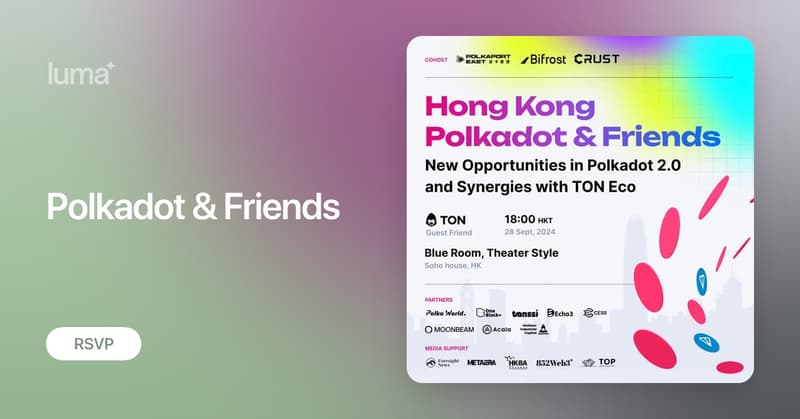
Saturday 28 September 18:00 GMT+8 33 Des Voeux Rd W Hong Kong Polkaport East, Crust, and Bifrost present the latest Polkadot and Friends event in Hong Kong, which will be exploring synergies with the TON ecosystem. The event will feature talks from Bifrost, Crust, OneBlock+, and a special guest from the TON ecosystem TOP (The Open Platform).

Polkadot, Property, Polimec, and Pizza
Thursday 26 September 17:30 CEST Reiffergässli 4 Zug, Switzerland Enjoy some pizza and drinks as Polimec hosts another night of ecosystem updates in Zug Switzerland. Bill Laboon (Web3 Foundation) will presenting some Polkadot updates, Richard Houldsworth will explain tokenized property investment with Xcavate, Flavio Bianchi will share what's change since the Polimec Evolution.


Polkadot Powering Progress in Public and Private Sectors
European Blockchain Convention FIRA BARCELONA MONTJUÏC Visionary Stage 25th September 15:25 CET On Day 1 of EBC2024, there will be a panel discussion on Polkadot's impact in enterprise and government, featuring Irina Karagyaur (BQ9/Energy Web X), Alan Vey (Aventus), Tom Humber (Archisinal), Nathalie Boyke (Web3 Foundation), and Ingo Ruebe (KILT Protocol).


DV Downsizing, Get Ready for the New Fab Five
The second cohort of Decentralized Voices concluded on September 10th, and the program has now entered a transitionary period. Votes after September 11th may not be counted if the referendum overlaps the onboarding of the next cohort. Cohort three of Decentralized Voices will introduce significant changes. Firstly, this time DV delegates will be delegated voting power on both Kusama and Polkadot. The number of delegates will be reduced to five, but may be altered at a later date. The length of delegation is being increased from three to four months, and at its conclusion, delegates will awarded 3500 DOT for their service. Applications for the third cohort are open until September 29th 2024.
Yikes, That's Some Ridiculously Cheap Coretime
Due to a mistake in sale price units, the sale base price of core time is 1 nanodot rather than 10 DOT. Whitelisted Caller Referendum 1172 needs to pass by Thursday 26th September to avoid that the five cores on the market do not sell for an unintentionally low price.


It's Spammin' Time
Amforc has intiated Referendum 1169 to fund a project which aims to showcase the scalability of the Polkadot Relay Chain. They are requesting 65K DOT to cover transaction fees and existential deposits to spam the relay chain to maximum capacity for a period of 30 minutes. At least 80% of the DOT requested will be returned directly to the treasury through transaction fees, with the effective cost to the treasury estimated to be 10.2K DOT.


JAMmin' with Gav in Singapore
Polkadot Decoded Asia Monday 16 September 16:00 GMT+8 Conrad Singapore Orchard Polkadot founder and chief architect Gavin Wood is back to deliver another keynote on JAM. Edit: Gav did not present on the scheduled topic, intead he presented: The Future of Individuality and Digital Governance in Web 3.0.

Mixing Polkadot Use Cases with DJ Hà Trang
Polkadot Decoded Asia Monday 16 September 15:30 GMT+8 Conrad Singapore Orchard DJ Hà Trang (Subwallet) speaks about improving the accessibility of Polkadot use cases in her talk SubWallet: Building a Polkadot Use Case Aggregation Interface for Mass Adoption.


Charu Chats About NFT Advancements
Polkadot Decoded Asia Monday 16 September 13:00 GMT+8 Conrad Singapore Orchard Charu Sethi (Unique Network) presents Advancing NFTs in the Polkadot Ecosystem. Unique Network tweeted: "you really don’t want to miss it 👀." Does she have a big announcement for us?


Polkadot from the VC POV
Polkadot Decoded Asia Monday 16 September 10:45 GMT+8 Conrad Singapore Orchard Joanna Liang (Jsquare), Rui (Hashkey Capital), Larry Ma (SNZ), and Gokhan Er (IOSG Ventures) share the VC perspective about the Polkadot ecosystem, and share their thoughts about its most promising sectors.





A BounDeFil Boost to the Ecosystem
The DeFi and Infrastructure Bounty has released its September 2024 Update, detailing funding for six projects. DIA received $119.25K to integrate trade data from the Hydration Omnipool and Bifrost DEX into its price feed oracle. A Child Bounty of $20K went to Alchemy Pay for the integration of Asset Hub DOT, USDC, and USDT into their on/off ramp. KILT's Polar Project which provides tooling for bridging Polkadot parachain native tokens to Ethereum with Snowbridge received €16.8K of funding. KuCoin received $80K for integrating Asset Hub USDC support. Harbour will receive €150K for integrating Asset Hub USDC, USDT, and DOT onto their Magic Ramps, which integrate personalized IBANs into Web3 wallets for seamless bank account transfers. For $136.8K, Dip Dup is developing API endpoints that give Polkadot developers access to live market data powered by Dexscreener. This will enable them to display prices charts and trading history for Polkadot ecosystem DEXs.
From SubZero to SubHero
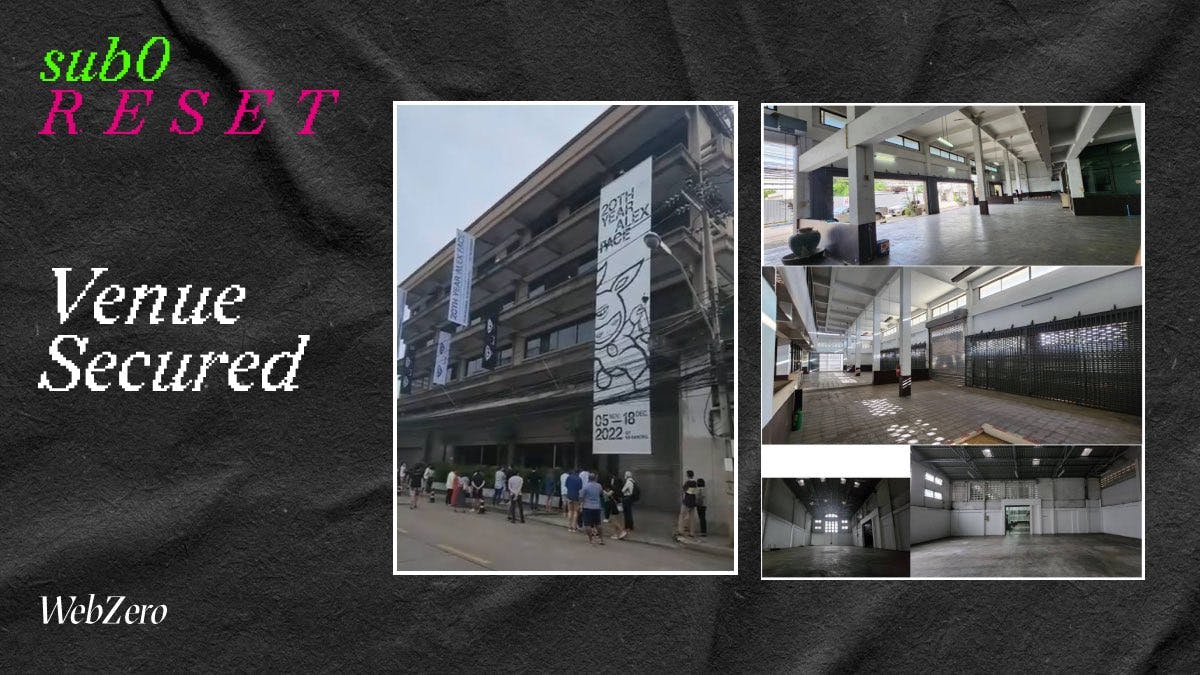
With the passing of Referendum 1113, WebZero's reimagining of Sub0 as grassroots, Web3 hacker culture, and Substrate focused event is set to take place in Bangkok from November 9-11. WebZero have secured a 5 floor building with rooftop big enough to host the main event, hackathon, and side-events. Tickets, food, and drinks will be free, and the agenda will be curated by ChaosDAO (why are they doing this?).
A Centrifugal Turn-around
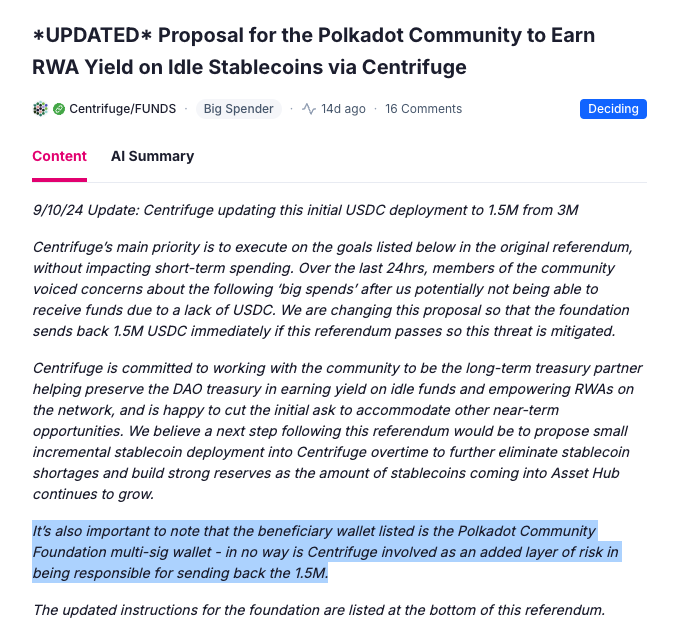
Big Spender Referendum 1122 has been amended to reduce the spending amount from 3M USDC to 1.5M USDC. Initiated by Centrifuge, the original proposal was to send 3M USDC to the Polkadot Community Foundation, which would then be invested in the UST Anemoy Liquid Treasury Fund. After concerns were raised by the community that there is not enough USDC in the treasury to cover upcoming USDC spend requests, Centrifuge has added an instruction to the proposal for the Community Foundation to return 1.5M USDC to the Polkadot Treasury.
Why Not a Little Lower?
A fourth proposal for adjusting inflation parameters has been submitted on the OpenGov Wish for Change track. A user by the name of Dobby proposes an inflation rate of 5% rate, with a constant 15% of inflation going to the treasury. Dobby appears to be waiting for a generous donor to place the 20,000 DOT decision deposit.
Bonus Hydrated Fortnight
Round 1 of the Polkadot Hydration campaign has been extended by two weeks to the 29th of September. This will give the community some additional time to discuss potential changes to Round 2 farms, and assess the impact of the Stellaswap incentives which went live on September 11th.

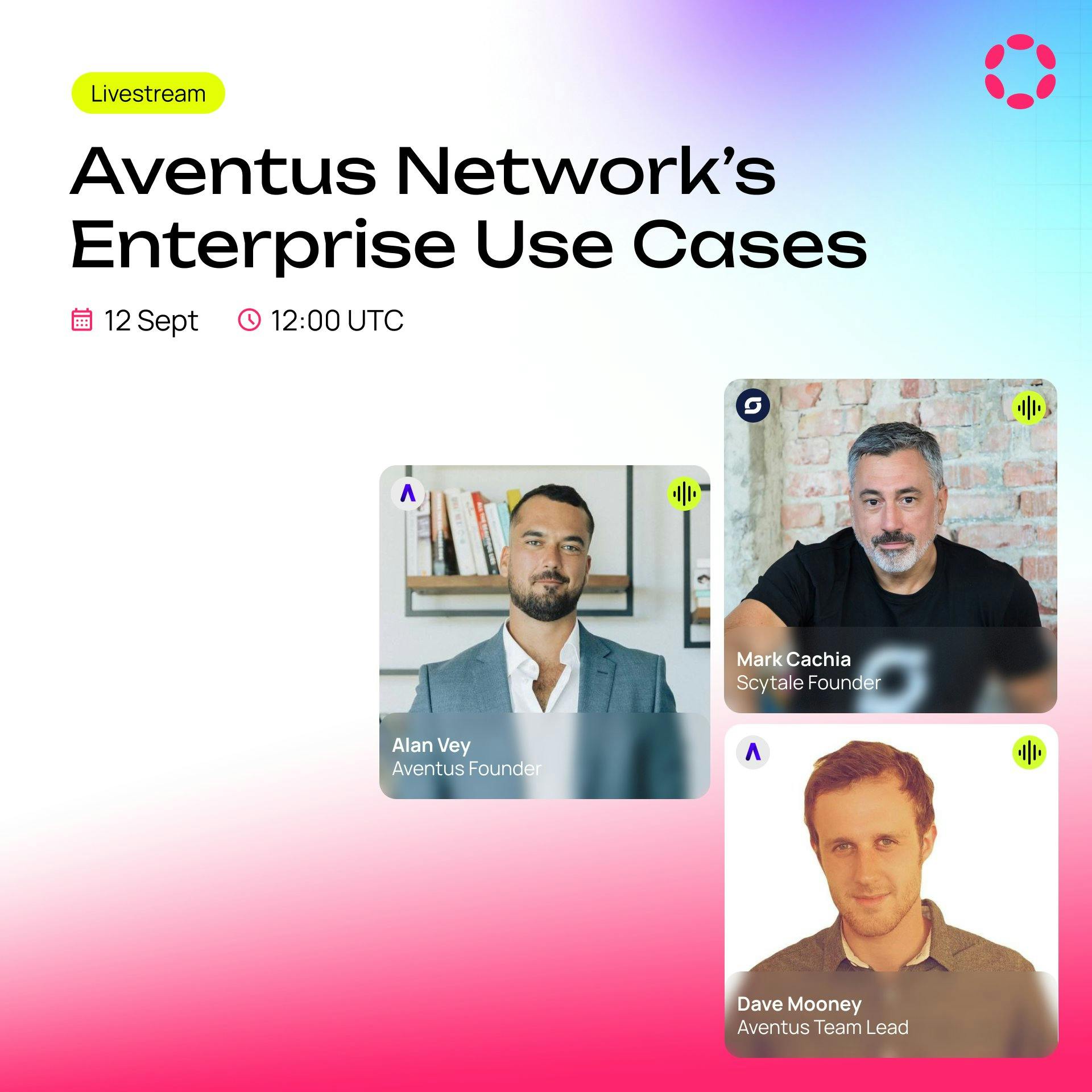
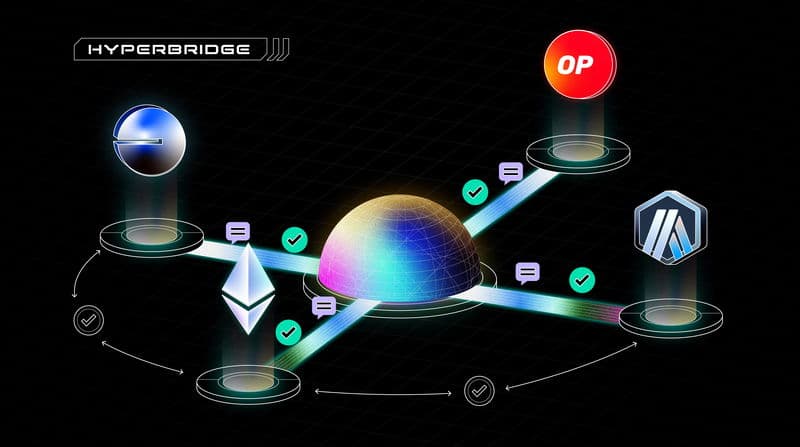
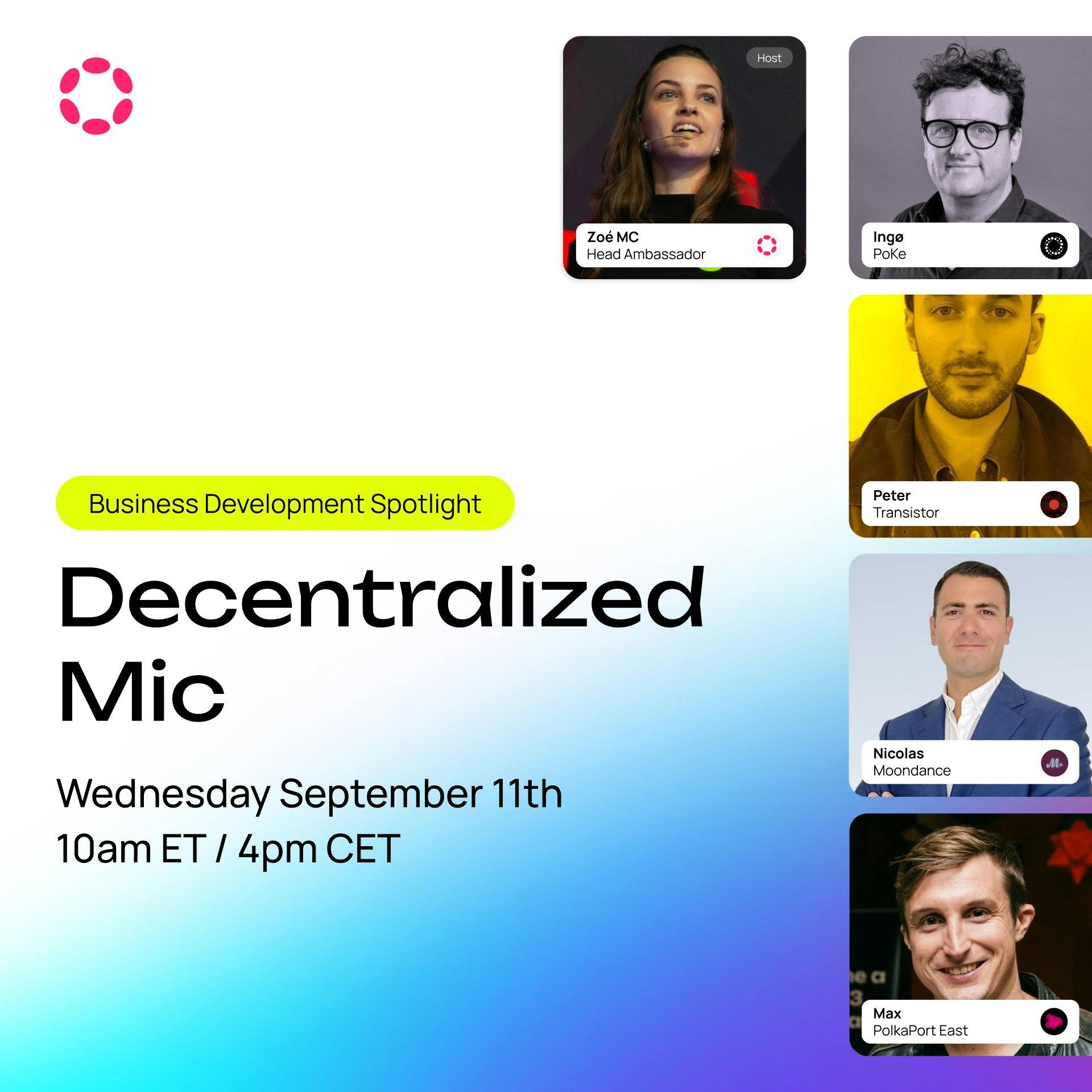
One Big Spend for Millions of Small Spends
The Polkadot Music Events Initiative (PMEI) have initiated Polkadot Opengov Big Spender Track Referendum 1141. It requests 1.13M USDC for the onboarding of Billfold, a cashless POS system provider for entertainment venues. This will cover the costs to onboard 3M active user accounts to Polkadot custodial wallets, add native crypto payments to Billfolds POS systems, build a loyalty reward system, and execute a marketing strategy. PMEI's expenses are covered by their recent Decentralized Futures Grant.
Coretime Runtime
Polkadot OpenGov Whitelisted Caller Track Referendum 1143 is open for voting. If passed it will upgrade the Relay Chain, Asset Hub, Bridge Hub, and People chain to runtime v1.3.0, and the People Chain to runtime v1.3.1. One more referendum will be required to to finalize the migration of Agile Coretime to Polkadot.
Bringing the Parachains to Paraguay
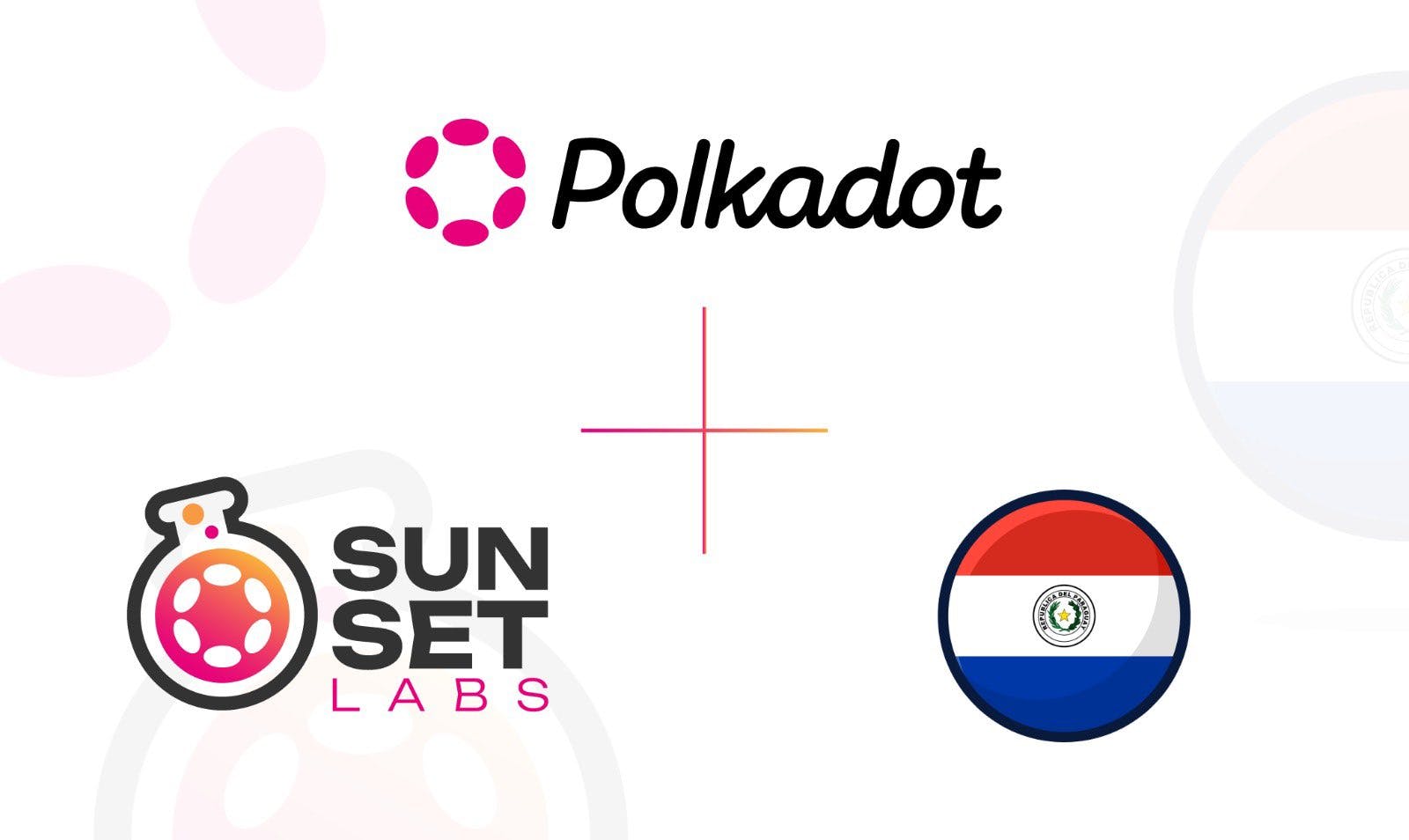
John Bartolome of Sunset Labs (Polkadot Brazil BD Team) announces a partnership with Paraguayan Blockchain Chamber. The partnership will be focused on the development of educational projects, enterprise solutions, and the chamber's initiatives to promote the adoption of blockchain in Paraguay.
Three Wishes from a Genie in a DOTtle
Jonas Gehrlein (Web 3 Foundation) has initiated three concurrent referenda on the OpenGov Wish for Change track, with the intention of forming a consensus on Polkadot inflation parameters. Referendum 1137 proposes maintaining a 10% rate, with a constant 15% of inflation going to the treasury. Referendum 1138 proposes an 8% rate, with a constant 15% of inflation going to the treasury. Referendum 1139 proposes linear inflation at a fixed number of tokens (potentially 8% of the current supply), and 15% of inflation going to the treasury. This would result in the rate of inflation lowering over time.





A Snowbridge Toll Reduction
Polkadot OpenGov Whitelisted Caller track Referendum 1127 is open for voting. It proposes to lower the pricing of Snowbridge transfer fees. The original Snowbridge pricing parameters were based on a worst case gas price of 60 Gwei and an ETH/DOT exchange rate of 1:450. This resulted in a Polkadot>Ethereum transfer cost of ~11 DOT and a Ethereum>Polkadot cost of 0.000399 ETH. If passed, the pricing parameters will be changed to a worst case gas price of 25 Gwei, and an ETH/DOT exchange rate of 1:566. This will result in a Polkadot>Ethereum transfer cost of ~6 DOT, and a Ethereum>Polkadot transfer cost of 0.000317 ETH.
Hey Good Lookin', Whatcha DOT Kucoin?
To celebrate the support of Asset Hub USDC/USDC, Kucoin have launched a DOT deposit campaign with a prize pool of USD$20K. To enters will need to make a net deposit of at least 500 USDT/USDC between August 30th and September 6th 2024. The maximum reward per user is USD$1,000.
More MYTH for the Active Polkadot Legends
Abilex, the Mythos Foundation administrators, have confirmed changes to distribution of the MYTH airdrop approved by OpenGov Referendum 643. The original plan was to airdrop 22.7 MYTH to holders of between 10 and 5000 DOT. A new set of criteria designed by Michael Naftaliev of Scytale Digital will see a larger allocation going to the most active wallets. There is a Dune dashboard detailing the criteria, with a list of the allocations for eligible wallets.
DeFi Autumn?
The Stellaswap DOT Incentive Program is finally launching on September 11th. One million DOT for the incentive program were granted to Stellaswap with OpenGov Referendum 580 in April 2024. The rewards will be spread amongst four categories - stablecoins, bluechips (DOT and GLMR), liquid staking, and native Polkadot projects. The incentive program will last for 12 months, with Stellaswap targeting a more than 10x TVL increase to USD$55M.


Bend DOT Like Beckham
Inter Miami announces Polkadot as its official Global Training Partner. The Polkadot logo will appear front and center on all training tops, with the first public appearance on Saturday August 31st at the Chicago Fire FC away match pre-training. At home games, Polkadot branding will appear prominently on various signage throughout Chase Stadium, and fans can look forward to some interactive fan zone activations.

Retroactive development for the last 8 months of Subwallet
The Subwallet team has proposed retroactive payment for the last eight months of their development work. The team has shared the work that has been done in the previous months, such as integrating the Polkadot Ledger App, adding Snow Bridge to the sub wallet, and more.


Say Hi to Michiko for Me
Monday August 27, 18:00 JST Wall&Wall (VENT), Tokyo The Polkadot Community of Japan is hosting a WebX 2024 side event in Tokyo, featuring music from DJ Emma, and talks by Seraya Takahashi (Web3 Foundation, Vincent Chan (PollkPort East), Rhee Sang Hyun (Moondance Labs), Charu Sethi (Unique Network).
Racing on the Treasurer Track
Conor Daly has initiated OpenGov Treasurer Track Referendum 1111, requesting 1,653,900 DOT (USD ~$7.5M) for Motorsports Sponsorship in 2025. The deal includes sponsorship of Conor in the full NASCAR Xfinity Season, and Indy 500. In addition, it includes a dedicated 3-layer PR x Comms Team, an Indy 500 hackathon, a B2B hospitality program, and a B2B enhancement team to broker new projects.
Codename Coretime
The Runtime 1.3.0 changelog has been published by the Polkadot Fellows. This will be the runtime that Enables Agile Coretime on Polkadot. Other notable changes include making the current inflation formula adjustable on Kusama, and the removal of all but the first 21 elected HAs from the Ambassador Program.
Are We Still Spending on Marketing?
In Opengov Medium Spender Track Referendum 1106, Coingecko have requested 240K USDT for a five month marketing campaign starting in September 2024. The deal would include 20 x Youtube pre-rolls/mid-rolls, an exclusively sponsored newsletter published 5 days a week, Monday-Friday.
DOTs for Kheops
Referendum 1102 on the OpenGov Medium Spender Track requests 14,092 DOT of retroactive funding for the Kheopswap DEX for Asset Hub. One of the first live DApps built with the Polkadot API (PAPI), Kheopswap already supports swaps, liquidity provisioning, and Asset Hub Relay Chain transfers and teleports. The requested amount would retroactively compensate approximately 480 hours of development.

Shhh... Don't Tell Them We're Layer 0
August 22nd 19:00 CEST Grand Bar, Oranienberger Str. 33, Berlin Alex Bird (Parity) will be presenting as part of Layer 1 Blockchains: Still a #1 Investment? It's a night for builders and investors to catch up on the latest developments in Layer 1 blockchains, featuring Polkadot, Algorand, Cosmos, and more.
Spotty and Frosty Foreign Assets Coming To Kusama
Pull Request 421 to allow Polkadot, Kusama, and Ethereum assets across the Polkadot Kusama bridge is nearing completion and isexpected to make it onto the Runtime 1.3.1 released around October. This will give the Kusama ecosystem access to Polkadot USDC, USDT, and Snowbridge Ethereum bridged foreign assets.
Sell Low, Sell High
Joe Petrowski has initiated Referendum 1104 Convert Part of DOT Assets to Stablecoins on the OpenGov Root track. If passed 5.25M DOT from the treasury will be converted to USDC and USDT over the course of twelve months using Hydration DCA trades. The parameters for the trades would be 20 DOT each of USDC and USDT every 20 blocks (approx. 4 minutes).

United By Blockchains
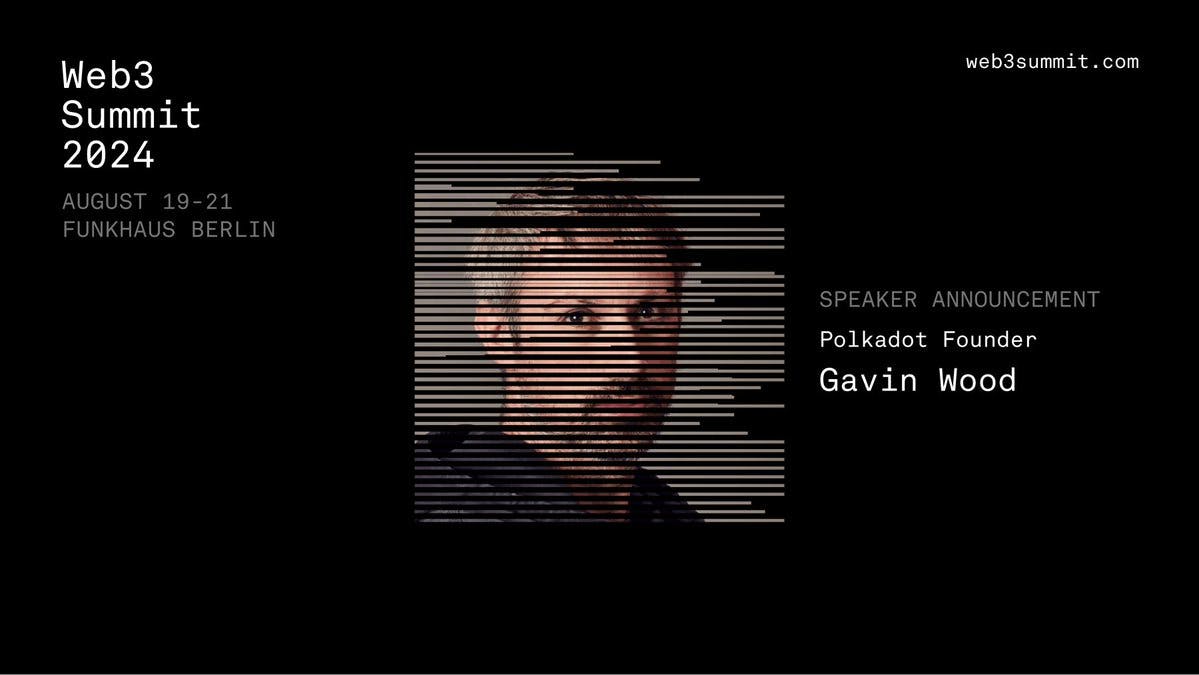
Tue Aug 20, 11:45 AM - 12:10 PM GMT +2 Web3 Summit FUNKHAUS BERLIN Studio One Unifying Blockchains: Innovations for Seamless Interoperability (Panel) Giorgio Zinetti (Cardano), Friederike Ernst (Gnosis), Susannah Evans (IBC Protocol), Seun Lanlege (Polytope Labs), and Shawn Tabrizi (Polkadot Fellow) discussed the unification of blockchains with seamless innovations.
Man on a Mission
Spazcoin is on a mission to connect the parachains through governance. With Zeitgeist Referendum 65, he proposes to open XCM channels with 16 parachains. Meanwhile, Proposal 33 aims to accept two incoming XCM requests. On Astar he has initiated a referendum to open 11 XCM channels, and on Acala he proposes to accept two incoming XCM requests.
Hey PAPI, We've Been Waiting for You
While there still many more features on the horizon, the dev team is confident in its stability and have decided to release Polkadot API 1.0.0 (PAPI), the first stable version. Originally funded by Opengov Referendum 467, PAPI offers a suite of modular Typescript libraries to streamline dApp building on Polkadot.
OpenZeppelin Makes EVM EZR
OpenZeppelin's new EVM template makes deploying a Polkadot EVM chain easier than ever. The latest EVM template now includes 20 byte address conversion, and adds account abstraction support. All issues ranked higher than medium identified by the Security Research Labs audit have been resolved.
Secure Like a Turtle Shell
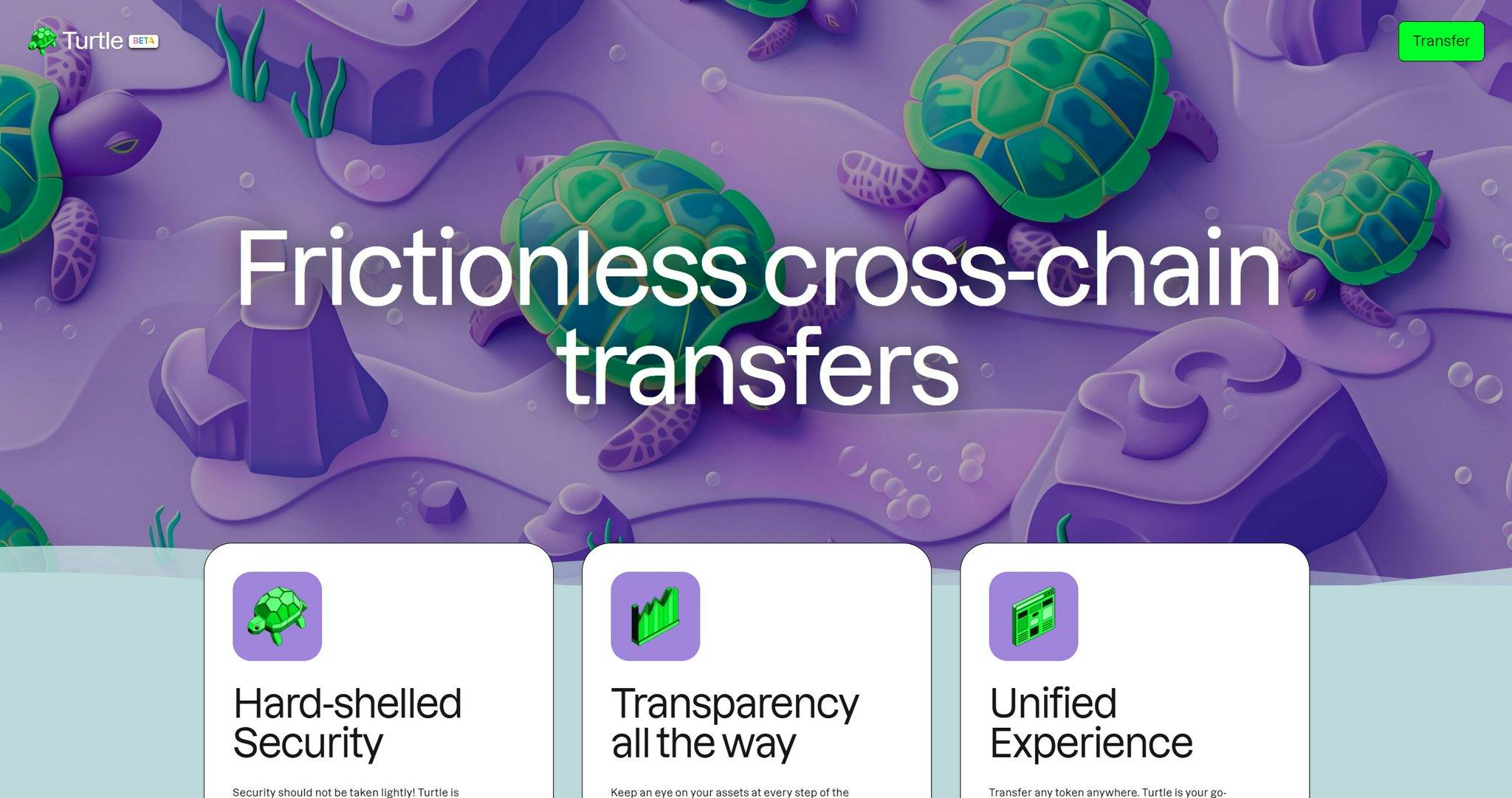
Velocity Labs introduces Turtle a new cross-chain transfer app powered by Snowbridge. Initially supporting EthereumPolkadot bridging, future plans will include widgets for all parachains, a Turtle SDK, cross-parachain transfers, cross-chain swaps, and on-ramp capabilities.

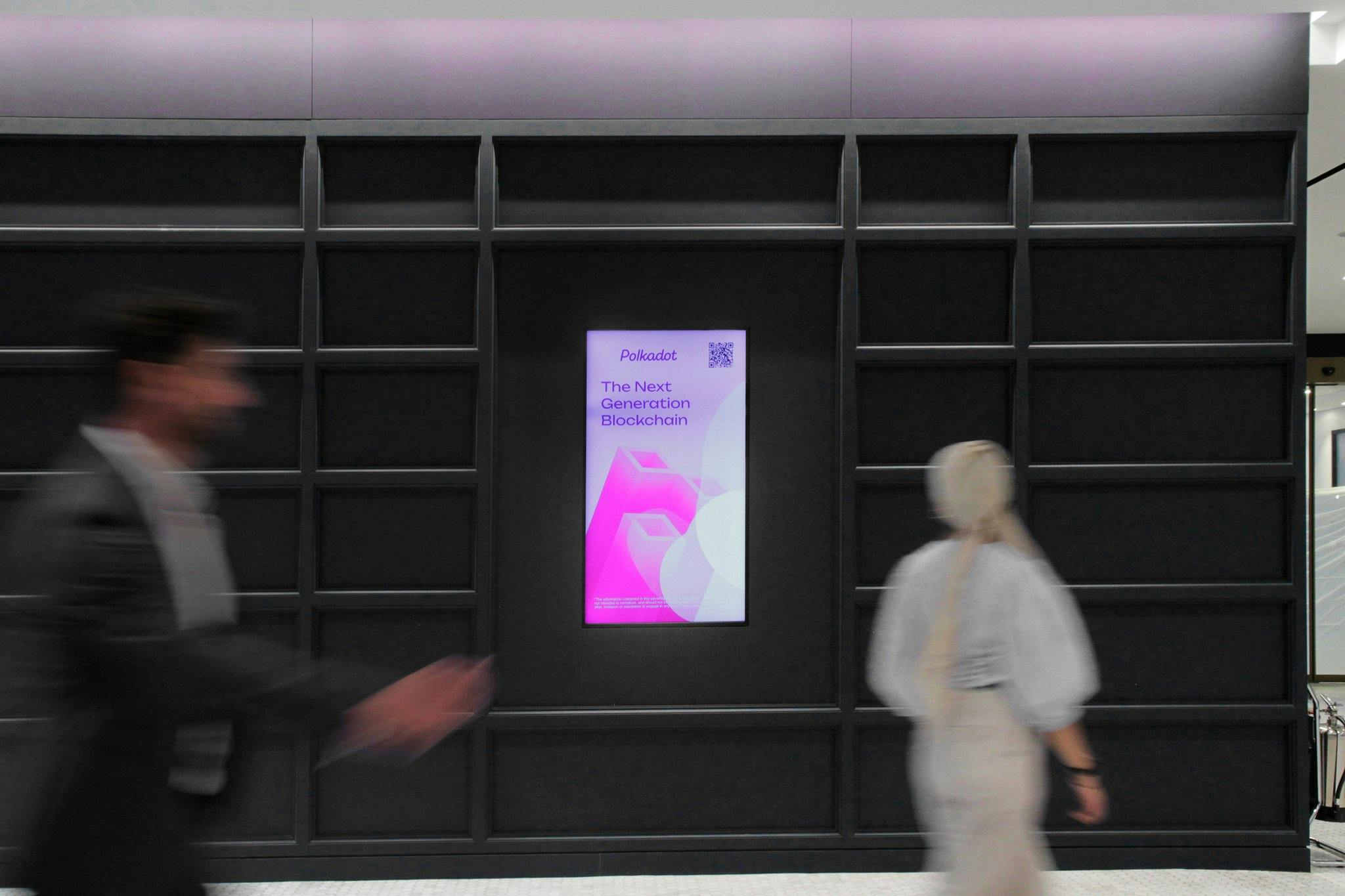
Canary Wharf? Why no Kusama?
CultureDot's latest Polkadot awareness campaign has launched in the financial districts of London City and Canary Wharf. The campaign targets relevant professionals by running a series of 10 second animations on 91 digital billboards in 41 office buildings for 5.5 months. The initiative is a result of Referendum #760 for 40K DOT.
New Website, Who Dis?
Polkadot's new website by Distractive has launched. It features new branding, and simplified messaging for newcomers to the ecosystem. It also features a decentralized job board and events page, with many more features on the horizon. But it has got people asking, what happened to our logo?


Shining a Light on Polkadot Marketing
Wednesday August 7th 17:00 CET https://x.com/Polkadot/status/1821199852023509032 Polkadot hosted The Decentralized Mic: Marketing Spotlight featuring Katie (Distractive), Nate (Distractive), Rachit (Airlyft), Jörn (Decentered Studio), Evan (Polkadot Social Media), Diogo (Polkadot at Universities)

What Lies Beyond the Chain?
Monday 5 August 18:00 BST Colours, Hoxton, London Beyond the Chain, a small scale networking event that highlights Polkadot and ecosystem projects, returns in 2024. Featuring Speakers Ben McMahon (Hydration) Tom Humber (Archisinal) And Panel: The Polkadot Treasury: Spending and Transparency Chrissy Hill (Parity), Remy Le Berre (Parity), Leemo (NovaWallet, Polkadot Head Ambassador, and more...
Bountiful and Eventful
The Polkadot Events Bounty announces the first round of approved events since their relaunch. Leemo was awarded $2500 to host the latest edition of Polkadot Beyond the Chain in London on August 5th. 19,613 DOT was allocated to Rhee for a Polkadot sponsorship and side-event at Korea Blockchain Week 2024. John Rhodel Bartolome was successful in his request for 74.504,00 USD in DOT for Polkadot to sponsor and participate in Futurecom Brazil 2024. Ximena from Distractive was granted $503,550.12 in DOT for Polkadot's sponsorship and participation in Token2049 Singapore. 3729 DOT went to Matt Santo to sponsor Nerdconf Argentina 2024 and organize a two day hackathon.

The drama never ends
There are calls for Michiko, who has recently been voted as a Polkadot Head Ambassador to proof their persona as it is otherwise thought to be fake persona. There is little activity and participation in calls, little or no evidence of their contributions to Polkadot and worse, their accounts are funded through Kraken which is banned in Japan. Leemo proposes to set a proposal to remove Michiko if adequate proof isn't provided. Really calls a lot to question.
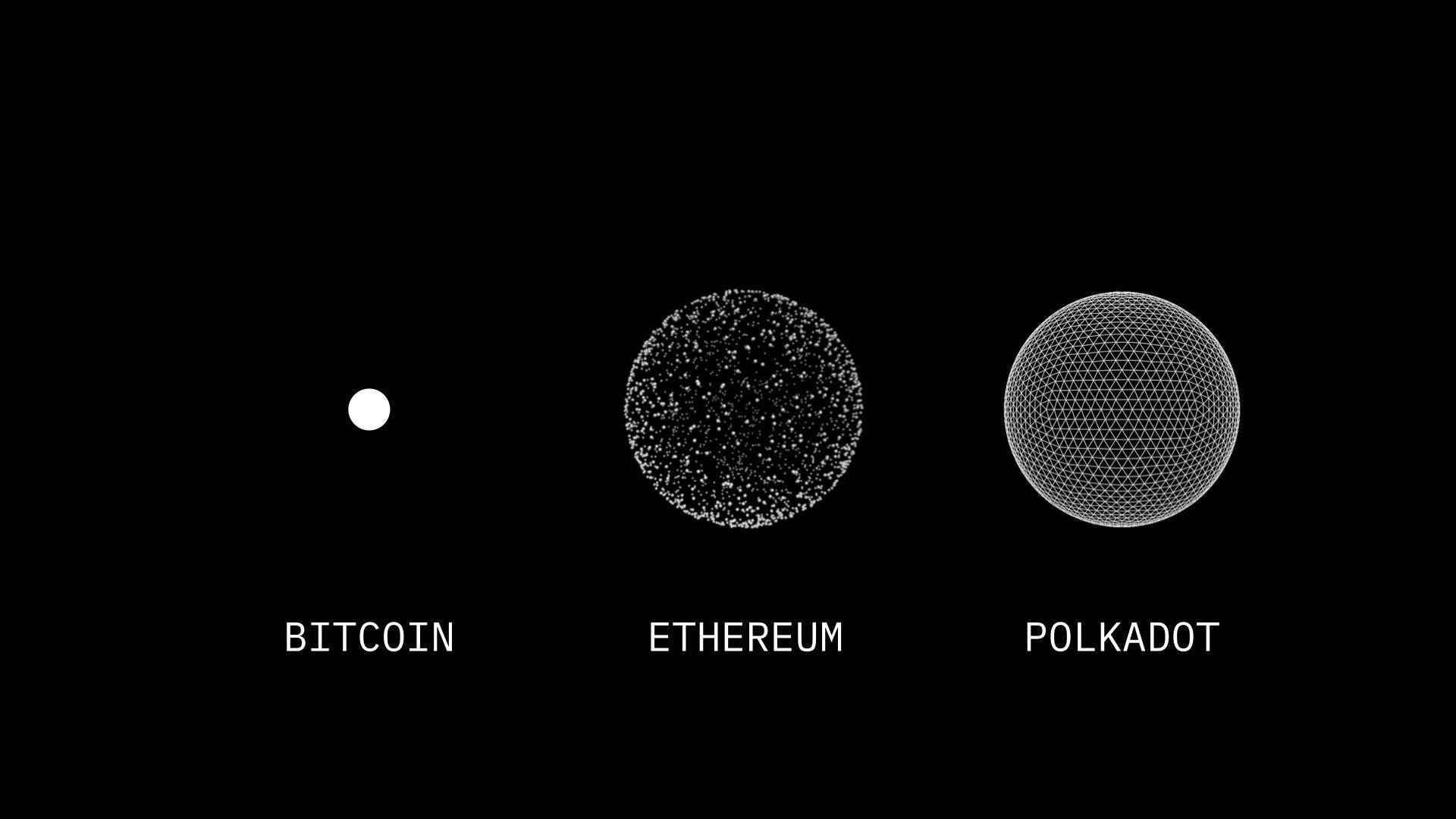
Looks Who's Back
Chainalysis have opened a discussion on Polkassembly to present their new and improved treasury proposal. This time they are requesting 6.5M USDC paid in three annual instalments, and their surveillance offer now includes monitoring of the DOT token on the Relay Chain, Hydration, Moonbeam, Asset Hub and Astar.
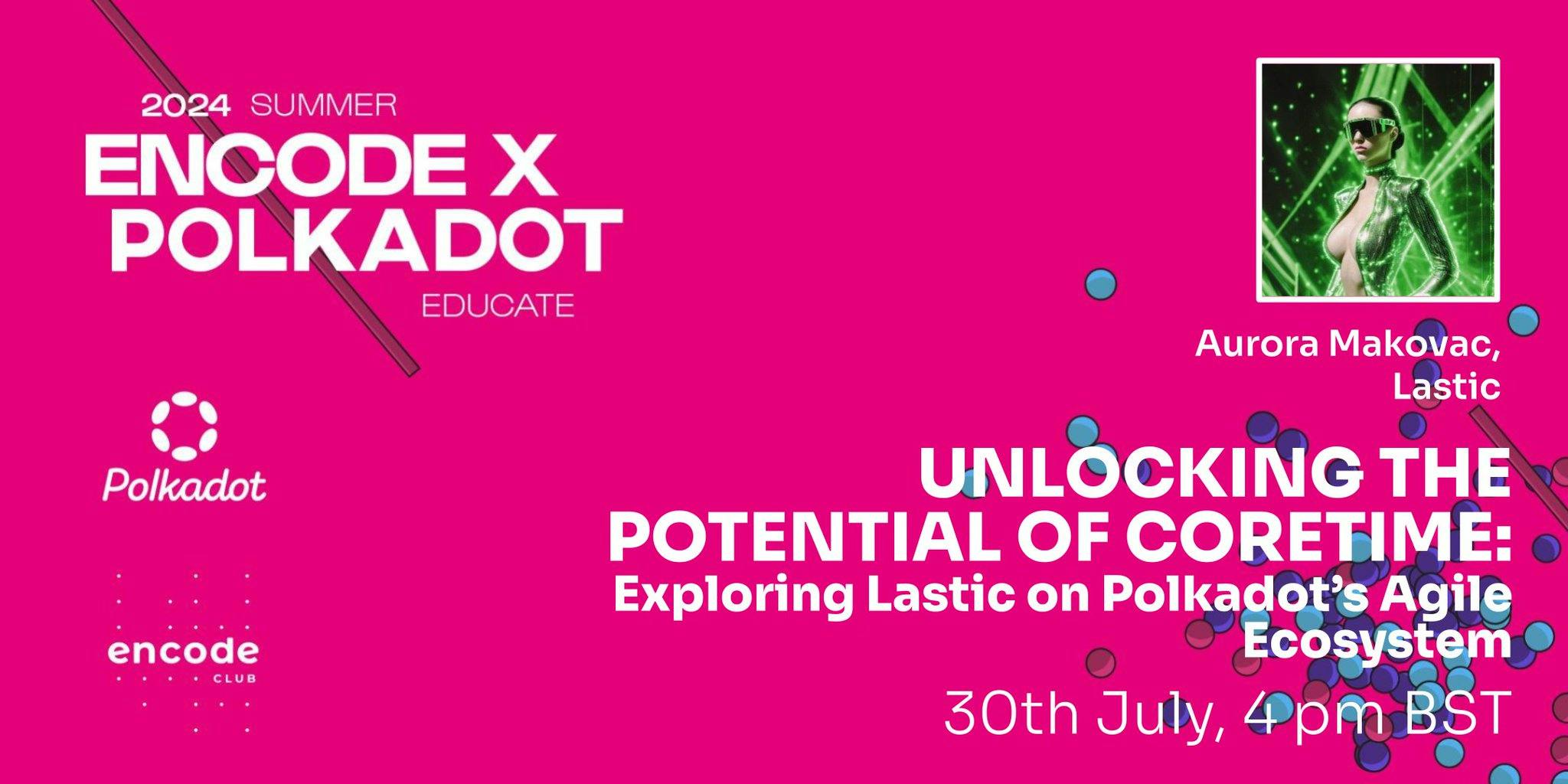

JAMmin in the Summertime
Tuesday July 30th 15:00 CEST Reiffergässli 4, Zùg, Switzerland Polimec hosts Polkadot Summer JAM, an afternoon off presentations and panels from leading figures in the industry. Featuring: Filippo Franchini (Web3 Foundation) - Let’s Talk about JAM Sascha Wullschleger (BIL) - Decentralised Lugano & the World of Polkadot and Scytale Dominic Weibel (Bitcoin Suisse) - Overview of the current Crypto Market Tim Weingärtner (DIDAS) & Ingo Rübe (KILT) - Panel: SSI, DID & Verifiable Credentials Luca von Wyttenbach (Polimec) & Ingo Rübe (KILT) - Panel: Polimec's Whitelabel Solution
A League of Legends
The Polkadot Assurance League (Bounty 22) have released their H1 2024 Community Report. In H1, they paid out over 150K DOT to subsidize 14 Rust security audits for 11 different parachains. In H2, with OpenGov approval, they will be expanding their support beyond parachains to include other consumers of coretime and Polkadot relay and system chains. Furthermore, they are planning support for Solidity audits and funding for security tooling and practices that will benefit the Polkadot ecosystem.
Shawn Shows You How
In his Ambassador Program 2.0 proposal, Shawn Tabrizi suggests that the threshold for Candidate Ambassadors to be promoted to Ambassador could be 5 successful tip requests of at least $200. To demonstrate how easy that would be, he has submitted a tip request for his work on writing his proposal.
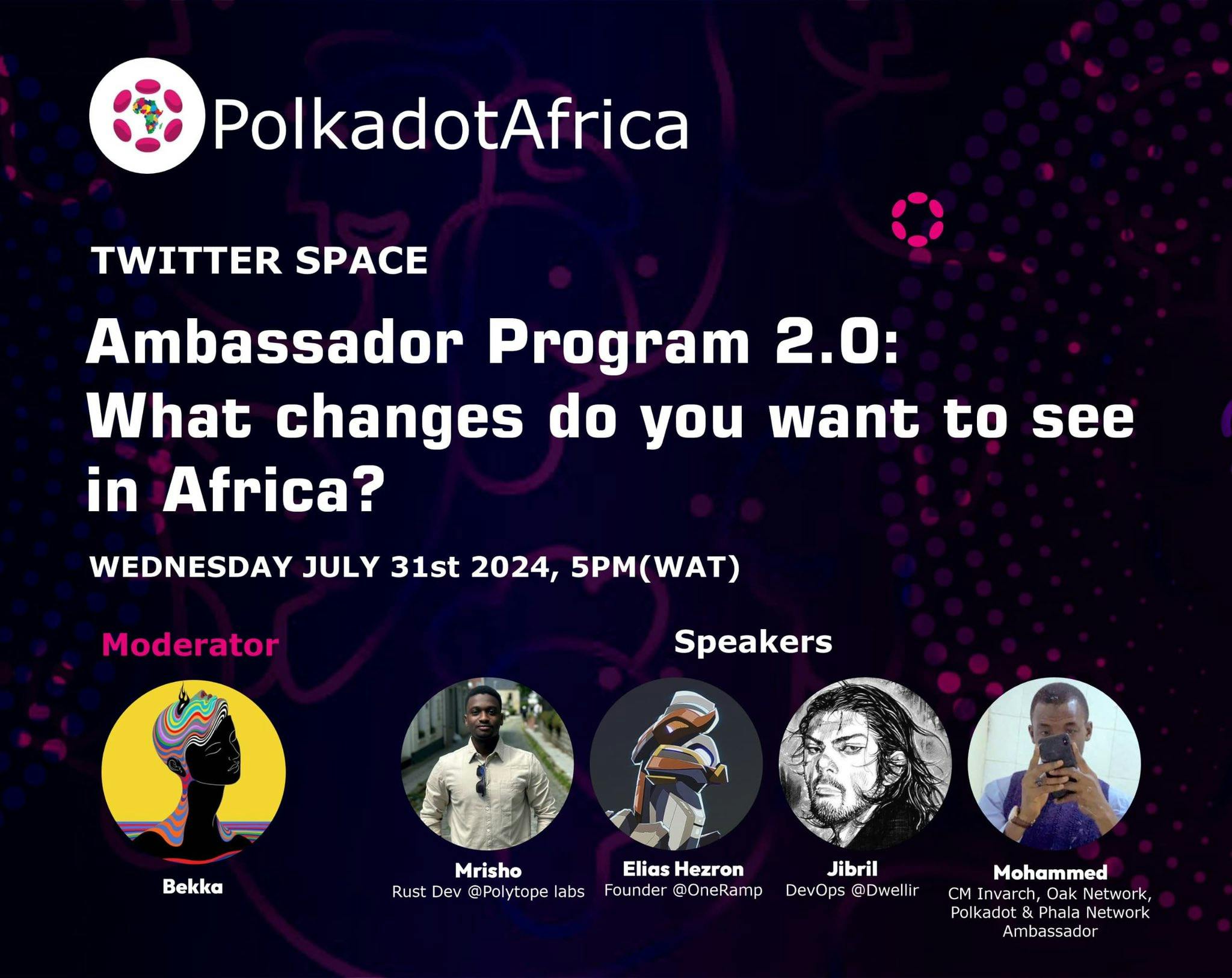
Shawn's Vision for the Polkadot Ambassador Program
Polkadot Fellow Shawn Tabrizi has published Ambassador Program 2.0 (Shawn's Vision), an alternative approach to the new Ambassador Program. Rather than having 21 head ambassadors on a $120k pa salary, he proposes two full-time roles of Ambassador Management compensated at OECD average salaries for Project Managers. The remaining ambassadors could work their way up through the ranks by meeting thresholds for treasury tipping and proposals. Shawn places emphasis on initial frugality and retroactive payment while climbing the ranks, with the idea that by the time an Ambassador reaches the higher ranks, there will be an opportunity to earn even more than $120k pa.
Surfing the Web3 Foundation Waves
The Web3 Foundation announces the grant recipients of Wave 22. Dastanbek Samatov will be developing an alternative approach to EVM compatibility on Substrate chains. Tuguldur Baigalmaa continues his XCM Tools project, enhancing crosschain messaging for the PolkadotKusama bridge, and updating the mainnet configuration of the Ethereum bridge. Sporyon Technologies are working on their Dotnix administrative tools for Polkadot validators. C Forge will improve & update Typechain for Polkadot to improve reliability and compatibility with ink! smart contracts. KodaDot will continue work on their NFT Indexer for Asset Hub. Cyborg Network are working on a proof of concept for their DePIN based marketplace for edge computing servers. Massa Labs are conducting research to develop the specifications of a new sub-consensus mechanism to improve confirmation times for the parachains.

The oldest DePIN project in the ecosystem wins the latest Polkadot Auction slot.
Robonomics have won the 75th auction with a self-funded bid and will be coming to Polkadot. The team will still be committed to Kusama where a freeium offering of their Web3 cloud IoT service will be offered. Much of the learning from Kusama will be applied to Polkadot, where the first commercial Roboservice will be launched in October and used by mult-apartment projects in Cyprus. Collators can still decide to support both implementations with block rewards in XRT. Additionally, the Polkadot Kusama bridge will make it easier to move tokens.

Shall We Deflate DOT Inflation?
Web3 Foundation's Jonas Gehrlein has published a proposal for adjusting Polkadot's inflation system on the Polkadot Forum. He suggests simplifying the model by removing the ideal staking mechanism which has become largely redundant with the introduction of Agile Coretime and revenue burning. He proposes a simple mechanism with APY increasing with a lower staking rate and vice-versa, and a fixed treasury inflow. These adjustments will be possible after new mechanisms are deployed in the next runtime upgrade. As an example he showed how inflation can be reduced to 8%, which would give a Staking APY of 11.62% at the current staking rate, with a treasury inflow of 1,155,529 DOT (fixed at 15% of inflation). The community is invited to get involved in the discussion and come to a general consensus so that an appropriate OpenGov referendum can be proposed after the runtime upgrade.
I Would Vote 1000 Times and I Would Vote 1000 More
Polkadot Governance has achieved the respectable milestone of 1000 referenda. To commemorate the occasion Distractive have submitted the 1000th proposal on the Wish For Change track, "A Wish for Continuity". If approved it will make the on-chain remark: Polkadot 4lyfe
Should the Polkadot Treasury Invest in the US Treasury?
Centrifuge has opened a discussion on OpenGov proposing that the Polkadot DAO make an RWA investment on Centrifuge in the Anemoy Liquid Treasury Fund (LTF). The Anemoy LTF holds US T-Bills with a maximum maturity of six months and has a target APY of 5%. The investment offers the Polkadot DAO stable yields while supporting the Polkadot RWA space and the Centrifuge parachain.

First Ever Initial Paranet Offering on Neuroweb
The PolkabotAI Initial Paranet Offering (IPO) is live, and open for voting. Polkadot AI is a trusted on-chain education agent for the Polkadot ecosystem powered by Origintrail and NeuroWeb. The IPO proposes 312,500 NEURO to incentivize knowledge miners (80%), active participation in governance (10%), and the paranet operator Trace Labs (10%).
Decentered Sub0 Proposal Gets a Frosty Response
Decentered have removed the preimage and requested for the community to vote NAY on Referendum 927. The referendum was originally requesting for 99,995 DOT for pre-funding of Sub0 Europe 2024, to be held in Barcelona. In light of community feedback to both the proposal and the recent Polkadot Decoded conference, Decentered have decided to postpone a decision on sub0 Europe 2024.
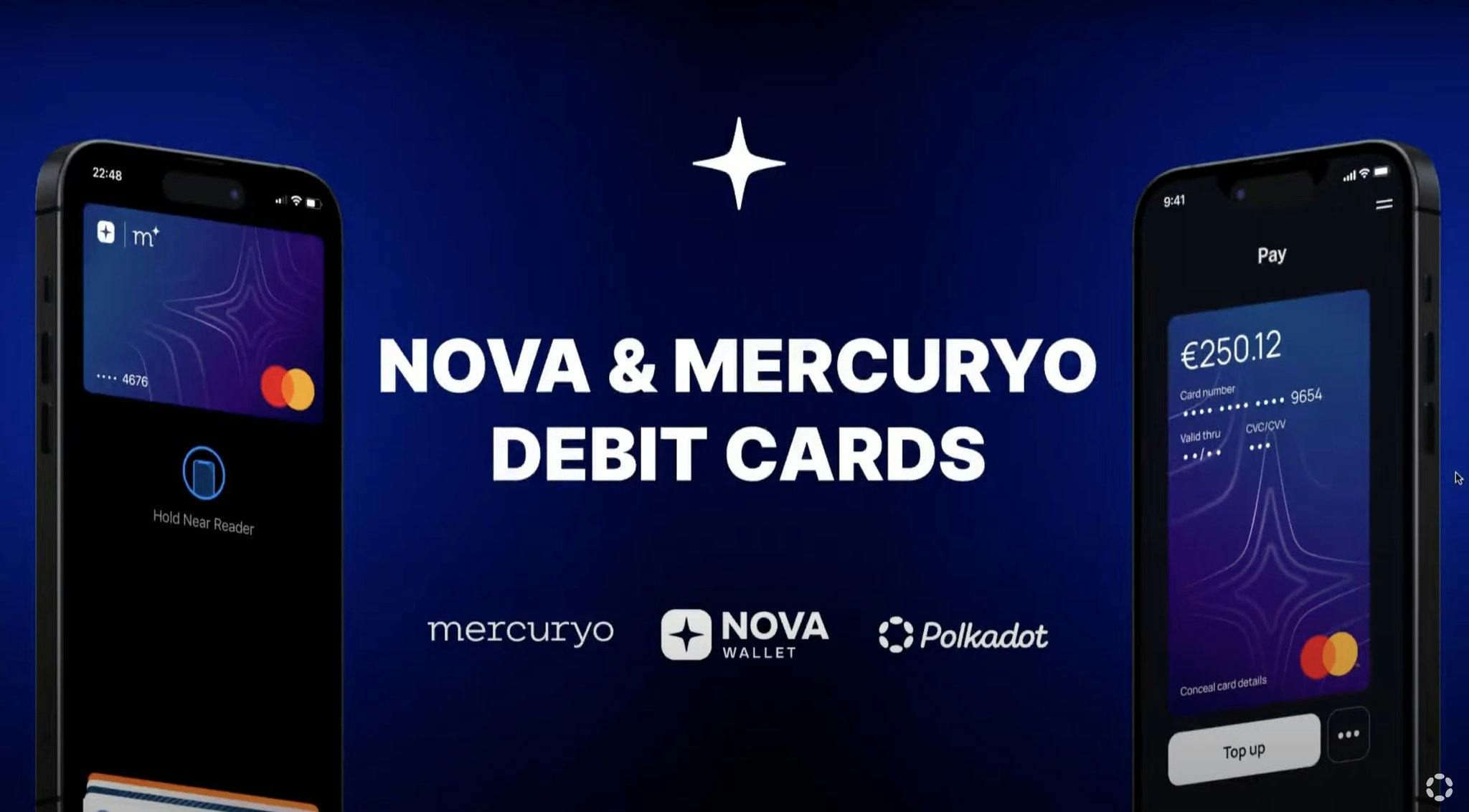
Debit Card Payments with NovaWallet? Priceless.
In partnership with Mercuryo, NovaSama CEO Anton Khvorov announces the new NovaWallet Mastercard Debit card. The first iteration of the cards (V1: Nova Spend Card) can be topped up using Polkadot ecosystem tokens via an off-ramp, and will be released in UK and EEA in September, and US and LATAM in 2025. The second iteration (V2: Nova Self-custodial Card) will be directly connected to NovaWallet and is planned for release in Q2 2025.
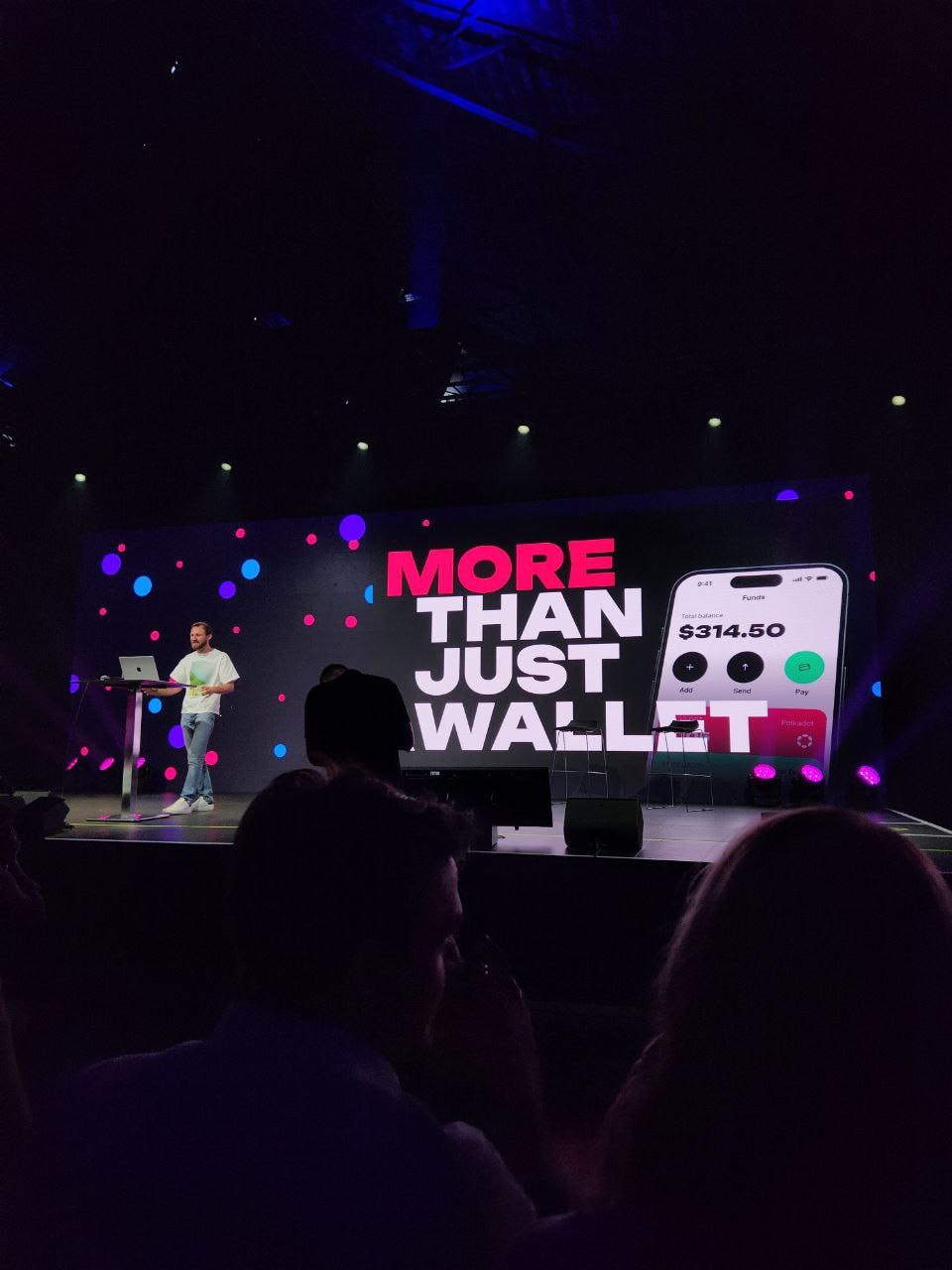
Pay, Send, and Stake on the New Polkadot App
At Polkadot Decoded, Parity CEO announced the new Polkadot App, due for release in Q3 2024. Touted as a product to onboard Web3 beginners onto Polkadot, the app is designed by Parity, built by NovaSama, with payments processing by Raise. No seed phrases, username, or password are required, instead credentials are backed up to Apple and Google cloud. Long and confusing wallet addresses are replaced with simple user names. The app will be able to send tokens such as DOT, USDT, USDC, with the option to send a link to SMS, WhatsApp, or email to quickly and easily onboard recipients. The app will also support one-click DOT staking. In partnership with Raise, Polkadot Pay brings in-app payment to 1M+ US stores, with plans to expand to 33+ countries later this year. Users can also receive up to 20% cashback in DOT. In the future, the Raise API will be available for integration in other Polkadot wallets. The Polkadot App will be wholly owned by the Polkadot DAO via the Polkadot Community Foundation.



Unifying and Standardizing Identity Mechanisms with Antonio
Thursday, July 11, 2024 15:20 CEST Polkadot Decoded: Impact Stage Antonio Antonino Software Engineer for KILT Protocol presents: "Identity Hub: The Next Version of the People Chain for the Benefit of the Whole Polkadot Ecosystem" He will present a proposal for Identity Hub, a framework for unifying identity mechanisms across the Polkadot ecosystem and beyond.
Deloitte Decodes Enterprise Engagement with DAOs
Thursday, July 11, 2024 16:10 CEST Polkadot Decoded: Impact Stage Kim Schneider Senior Manager of Web3 at Deloitte presents: "Unlocking enterprise potential - engaging with DAOs" She'll discuss the regulatory challenges of corporations engaging with DAOs in the in the constantly evolving Web3 landscape.
Unite and Conquer with Tommi
Thursday, July 11, 2024 14:45 CEST Polkadot Decoded: Impact Stage Tommi Enenkel (Alice und Bob, ) presents: "State of the Union: A Status Quo and Strategy for Polkadot Ecosystem Development" He will address the current state of the Polkadot ecosystem and propose a development strategy for its future.
Nikhil Decodes the Future of Polkadot Governance
Thursday, July 11, 2024 13:50 CEST Polkadot Decoded: Impact Stage Polkassembly CTO Nikhil Ranjan presents: "Future of Governance & Decentralisation at Polkadot" He'll guide us through some of the latest changes to governance, such as Collectives, as well as how identities and reputation will become more important in the future.
Keynotes from Key Players
🗓️ Thursday 11th July 11:05 CEST 📍Polkadot Decoded Main Stage Polkadot Decoded 2024 kicks off with keynotes from Parity CEO Björn Wagner, followed by Chief Architect Gavin Wood. Neither have let slip what they'll be talking about, so you'll just have to be there. In-person (paid) and virtual (free) tickets are still available.
Could I Borrow a DOT?
Kylix Finance, an advanced DeFI lending platform, receives one of the final Web3 Foundation Decentralized Futures grants. Kylix offers a multi-chain lending platform with permissionless creation of lending pools, strong incentives for liquidity providers, and on-chain auctions for liquidating collaterals.


Gavin Teaches ETHCC a Thing or Two About Decentralization
🗓️ Wednesday 10th July 12:25 CEST 📍ETHCC Gold Hall Immediately before Vitalik Buterin's keynote, Gavin Wood will be warming up the crowd with his speech titled: "Building True Unstoppability: Protocol-Hosted Decentralised Protocol Development".


Build, Launch, Bridge and More...
🗓️ Tuesday 9 July 11:00 CEST 📍Pt Rue des Bouchers 6, Brussels Belgium WebZero hosts Polkadot Builder's Day at The Blockspace Hacker Café (Sneaker Café) in Brussels. Agenda: "The Polkadot Ecosystem: Unveiling the Potential DOT by DOT" Ezio Rojas and Blockya (Polkadot Head Ambassadors) "How to launch your Parachain" Radha Dasari (Web3 Foundation) "Hyperbridge for secure cross-chain messaging" Workshop -Seun Lanlege (Polytope Labs) "The UX Landscape for the Future of Bridging Protocols" Panel - Clara van Staden (Snowbridge), Seun Lanlege (Polytope Labs), Alberto Viera (Paper Moon).
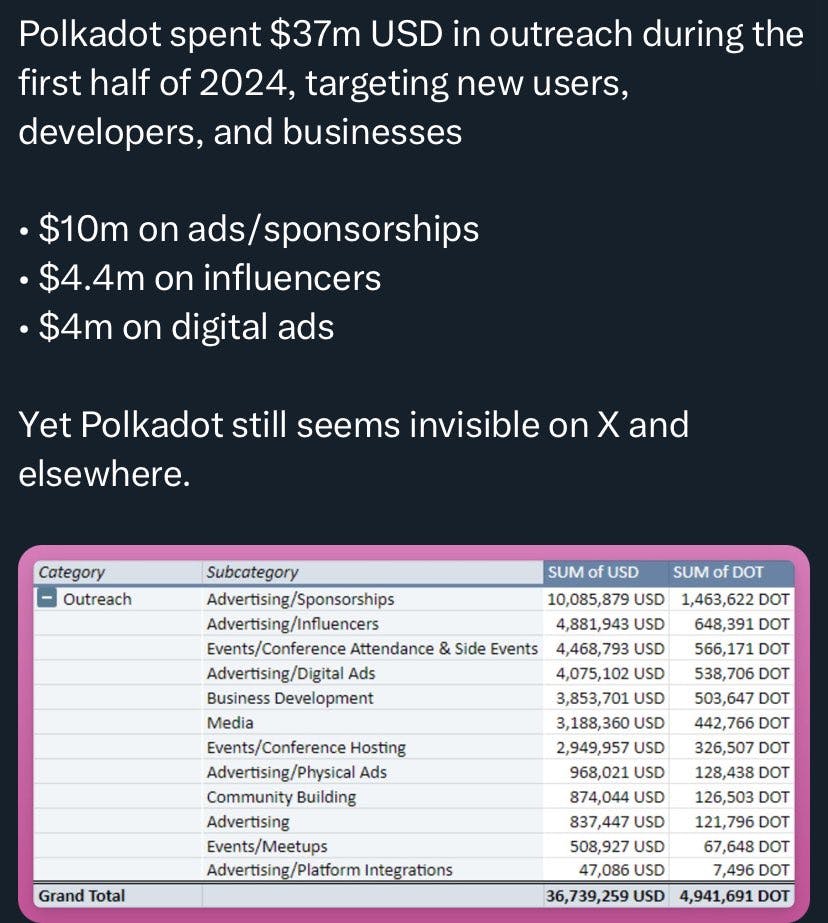
Add in an Ecosystem Resource Center
The Ecosystem Resource Center by Distractive is providing Polkadot community members, builders and enthusiasts with resources and tools to meet their marketing and event goals. These include social media guidelines and co-marketing request forms, branding resources, resources for event planning, tutorials on how to set up treasury proposals and more.

Real World Talks on Real World Assets
🗓️ Wednesday 3rd Jul 2024 19:00 BST 📍 Sway Bar 61-65 Great Queen Street London A real world event exploring Real World Assets in the Polkadot ecosystem featuring presentations by David Bakk (Polimec), Richard Houldsworth (Xcavate), Shalydon Brown (Proof of Law), Tom Humber (Archisinal), and Sean Murphy (Impactscope).
Finishing Up That Half-Full Glass
Gavin Wood and Mark Cachia are back to finish of that hefty pour of Kavalan Podium in A Glass With Gav Episode 3. In this episode Gavin shares his ideas mass market adoption of technology and how much further blockchain technology will need to progress before it truly hits the mainstream. On first generation blockchain technology he says, "Proof of Work is proof of waste... it's the fossil fuel of consensus." The introduction of "programmable money" and proof of stake in blockchain's second generation is an improvement, but lacks scalability. The problems that need to be solved for the third generation of blockchain are achieving "actual" decentralization, and scalability to the point where the volume and price point make it accessible to mainstream markets. Gavin argues that Ethereum's current scalability solutions are less secure (L2s) and far too computationally expensive (ZK SNARK) compared to Polkadot's Nominated Proof of Stake system.

Outreachious Spending
The Polkadot Treasury report for the first half of 2024 has been published. Polkadot currently has assets equivalent to 245m USD. First half spending totalled USD 86.5M with the biggest spend (USD 37M) on outreach. The smallest spend category (USD 2.1M) was research. The treasury could maintain this spending rate for approximately 2 more years.

Events Horizon
DOT Events Bounty is now accepting applications for event funding. Community organized Polkadot Meetups aimed giving updates and promoting the technology can apply for up to USD3.4k of funding, or USD10k for multiple events. Organizers will be rewarded with between USD250 and USD500 depending on attendance. Key Events and Extraordinary events do not have a funding cap, but production, budgeting, marketing, and reporting requirements are far more stringent.
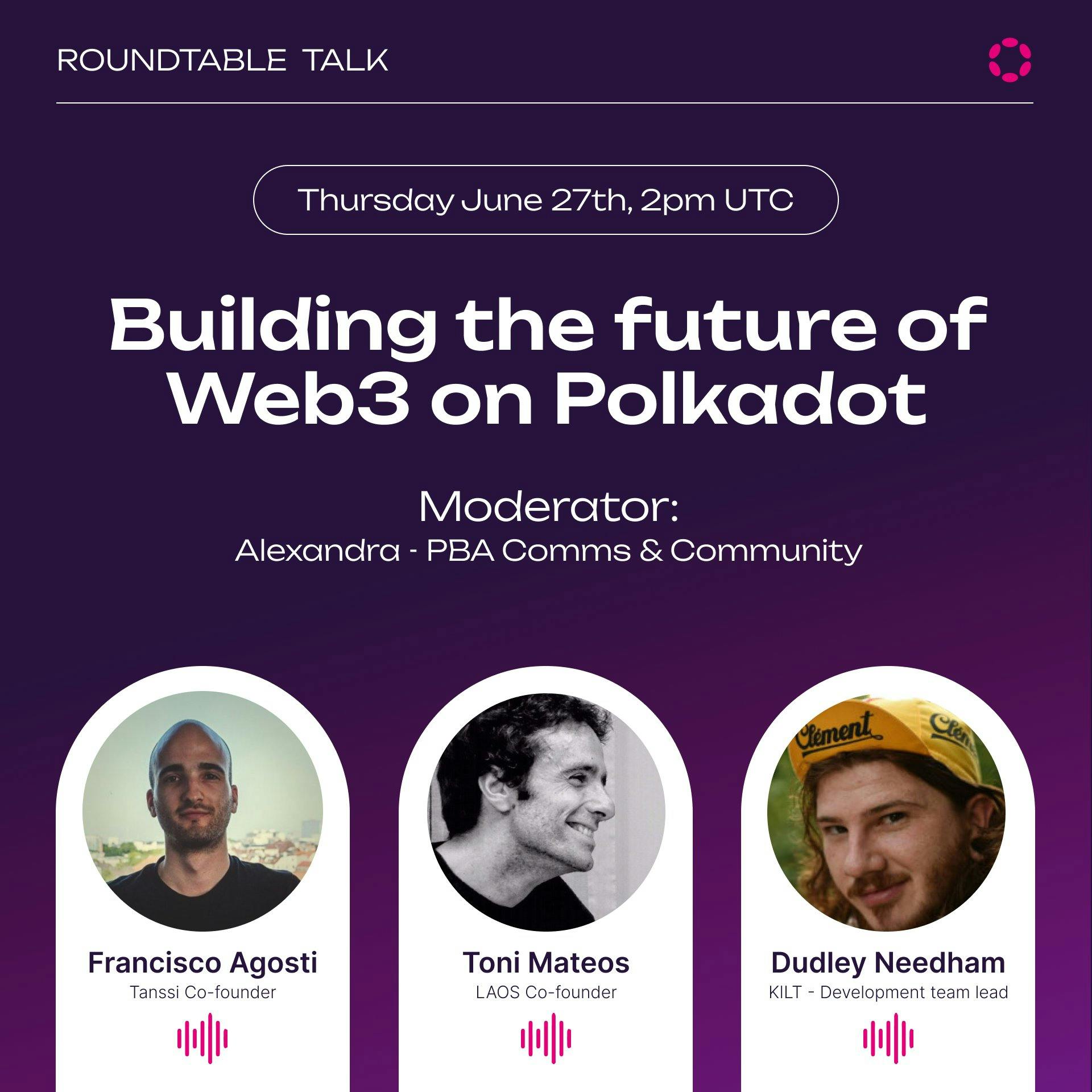


All Aboard the Polar Express!
Snowfork announces that Snowbridge, the trustless EthereumPolkadot bridge, is now live on Polkadot. In the first release the focus in on transferring ETH and ERC20 assets between Ethereum and Polkadot. An initial scale test is running for the first two weeks, with admin features enabled for upgrades and bug fixes. The bridge will go fully trustless using cross-chain governance after this period. Snowbridge assets are not supported on Talisman, SubWallet, and Nova Wallet yet, but balances can be viewed and transferred on the Snowbridge website. Bridging Polkadot-native assets is expected to be enabled in the next few months at the same time that the arbitrary messaging feature is released. Stay tuned for news about a new governance proposal for long-term funding of Snowbridge and a liquidity program.
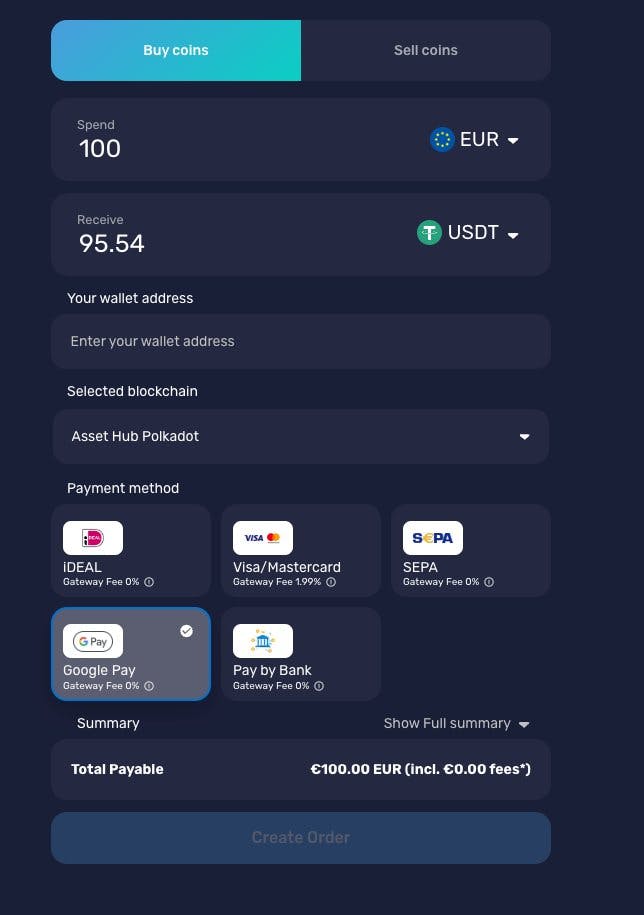
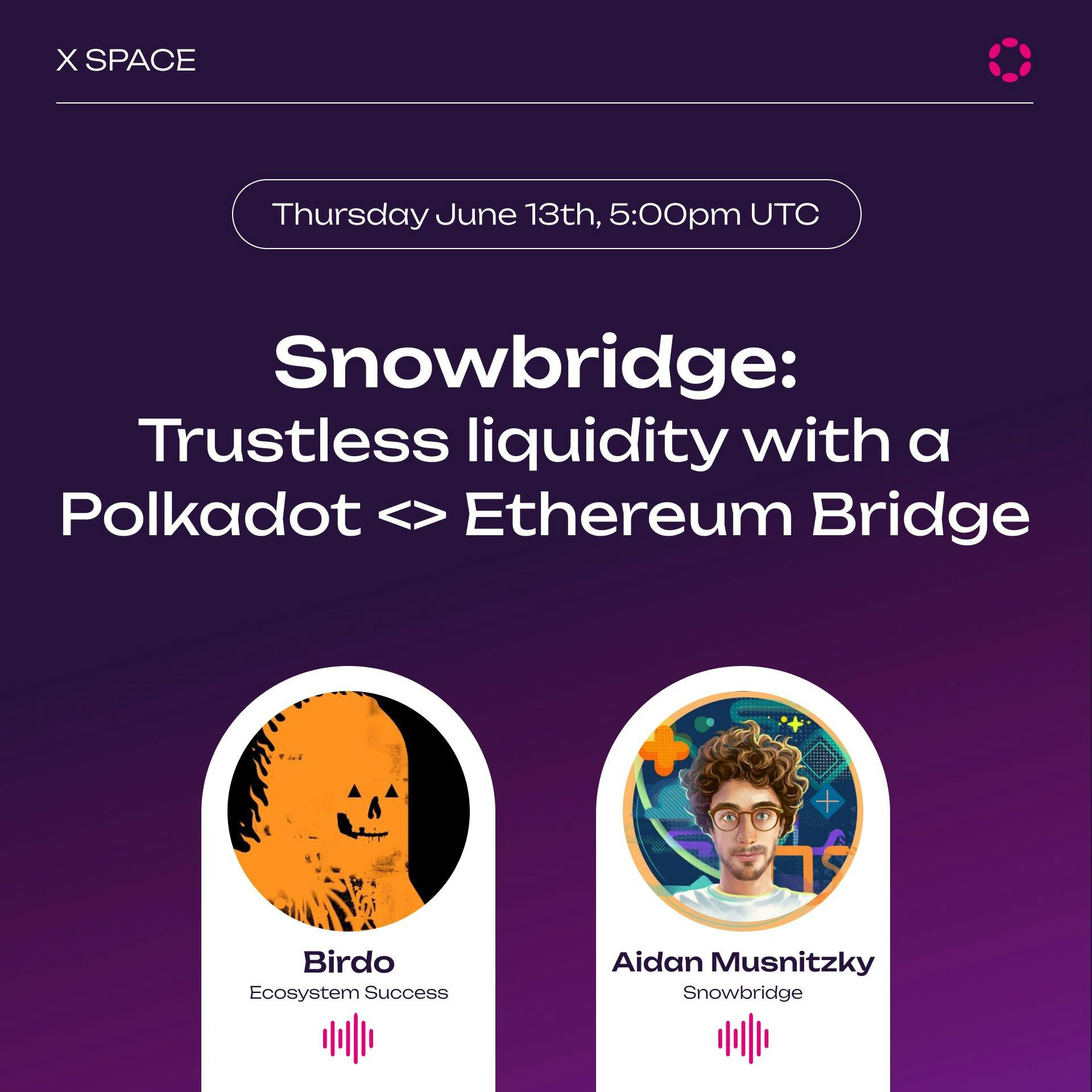

Goodbye and Thanks for all the Pizza
🗓️ Friday, June 14 2024, 19:00 CEST 📍 Apillon HQ, Litostrojska Cesta 40 The grande finale of Polkadot Meetup season in Ljubljana. Hosted by Apillon, enjoy some pizza, beer, and speakers from Deutsche Telekom, Oasis Network, and Flare. Speakers: -Benjamin Balzer, CMO at Deutsche Telekom MMS, Web3 Unit -Matej Janež, Business Developer at Oasis Network -Luka Avbreht & Filip Koprivec, Senior Solidity Engineer & Head of Dev Rel at Flare Network -Damjan Dimitrov, Senior Backend Engineer at Apillon
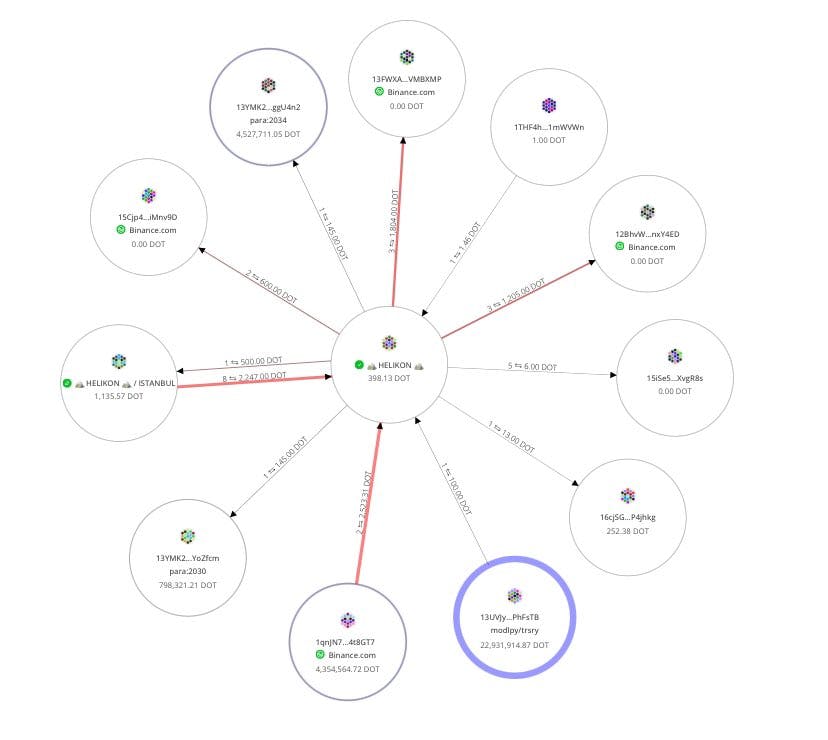
A New Polkadot Tshirt to Add to the Collection
Leading esports organization HEROIC announces a new sponsorship deal with Polkadot. Polkadot will become the official blockchain sponsor of HEROIC, featuring prominently on their team jerseys, digital platforms, and collaborative promotional activities

Accelerate Polkadot receives Decentralised Futures Grant
The Web3 foundation announced that Accelerate Polkadot has been chosen as the latest beneficiary of the Decentralised Futures Program. Accelerate Polkadot supports developers in the Polkadot ecosystem with goal-oriented learning, a code-first approach, and reliable content. It is open-source and promotes collaboration, transparency and community among developers, providng an enabling environment.

Judgemental Fellows
With the Polkadot community's ratification of JAM as the next major version of Polkadot complete, the Fellowship are now voting in a referendum to the ratify and accept their role as judge in the JAM Protocol Prize. If passed, the fellowship will judge the JAM Protocol prize in accordance with the rules stated in https://jam.web3.foundation/.
Polkadot BD in Brazil
Proposal 818 on the Medium Spender track aims to expand the Polkadot ecosystem in Brazil through partnerships and collaborations, focusing on blockchain technology integration. Key points include the objective to convert interested parties into Polkadot builders or partners, educational strategies, account management, transformation in large companies, and support from parachains. The diverse team and experienced curators support the initiative, with a compensation structure based on goal achievement. In summary, the proposal offers a comprehensive approach to Polkadot ecosystem development in Brazil, emphasizing education, partnerships, and cultural transformation within companies, ensuring effective progress tracking and results monitoring.
Polkadot UX revamp - Bounty
Proposal 819 on the Medium Spender track focuses on enhancing the user experience in the Polkadot ecosystem by addressing UX challenges and introducing innovative solutions using the Polkadot SDK. Led by Braille, a team of curated ecosystem leaders will oversee the initiative to improve accessibility and user-friendliness, driving widespread adoption in the Polkadot community.

Polkadot Updates - Hosted by Polimec
🗓️Wednesday 29th May 2024, 17:30 CEST 📍4 Reiffergässli 6300 Zug Switzerland 18:00 Joe Petrowski from Web3 Foundation, and Flavio Bianchi from Polimec will have a fireside chat about what's been happening with Polkadot. 18:00 Flavio Bianchi presents the latest from Polimec.
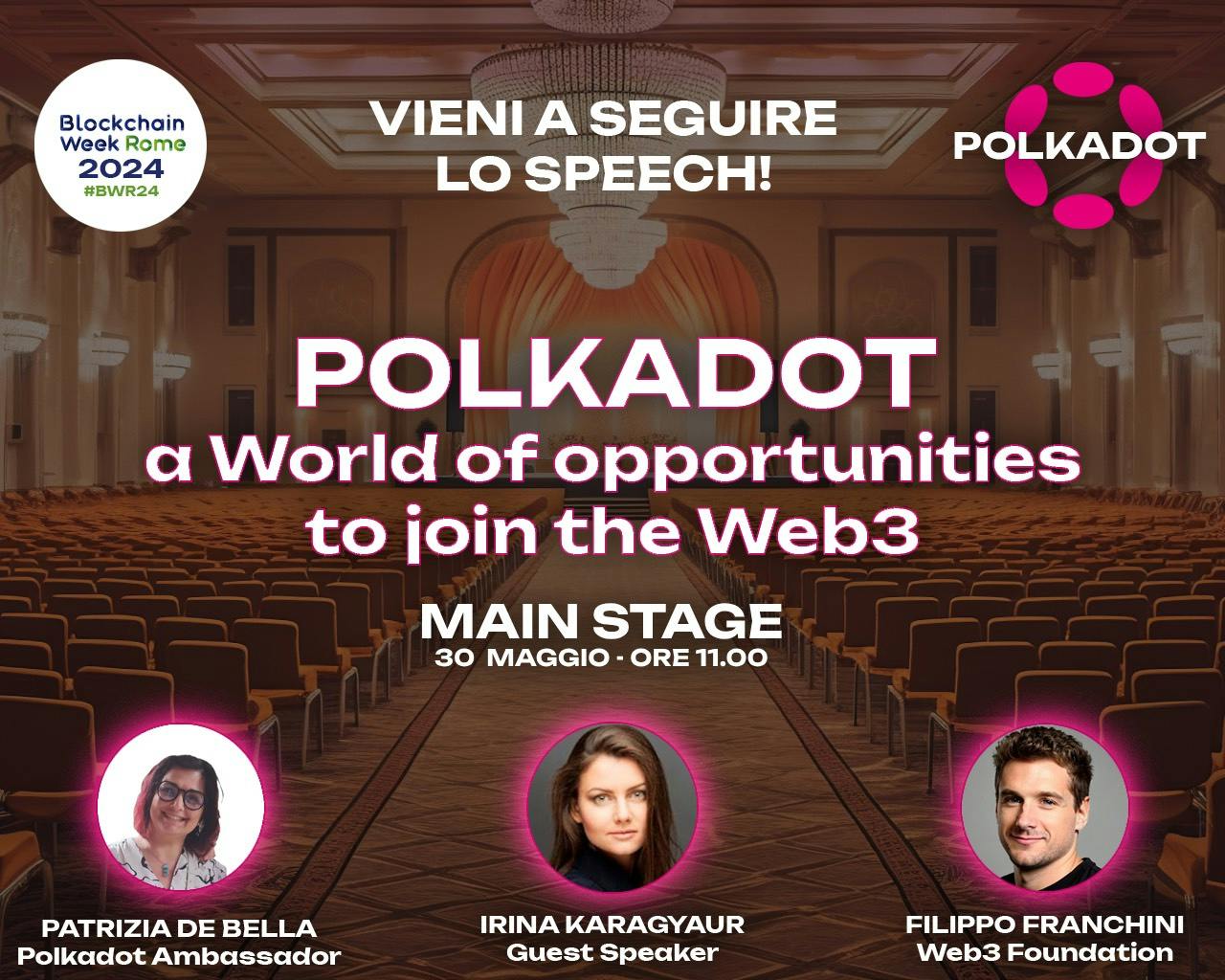
Polkadot: A World of Opportunities to Join the Web3
🗓️Thursday 30th May 2024, 11:00 CEST 📍Blockchain Week Rome 2024 - Main Stage Featuring: Filippo Franchini - Web3 Foundation Irina Karagyaur - Polkadot Head Ambassador Patrizia De Bella - Polkadot Head Ambassador Topics: -Financing: Grants, Treasury, and Bounty -Infrastructure: Nodes and Collators -Polkadot Careers -Polkadot Academy and Learning -Gaming and Projects
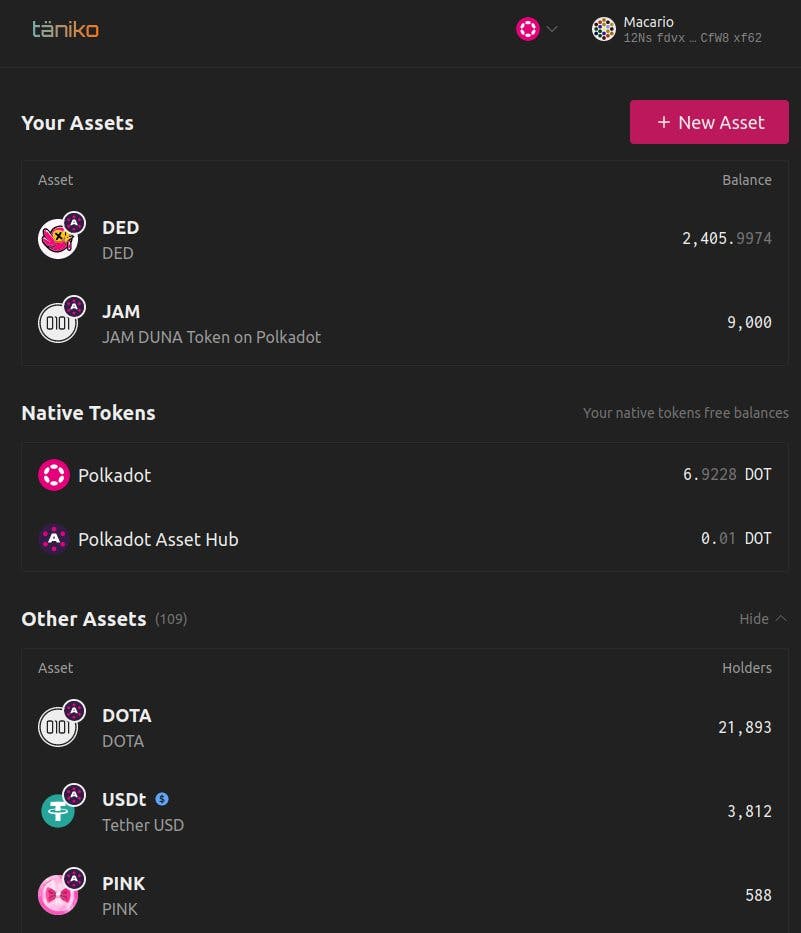
High Velocity Future Fund
Ecosystem builder and venture studio Velocity Labs has been awarded a Decentralized Futures grant. Velocity Labs aims to transform Polkadot into an innovative DeFi hub through initiatives to improve the infrastructure of the Polkadot ecosystem and attracting high quality projects.

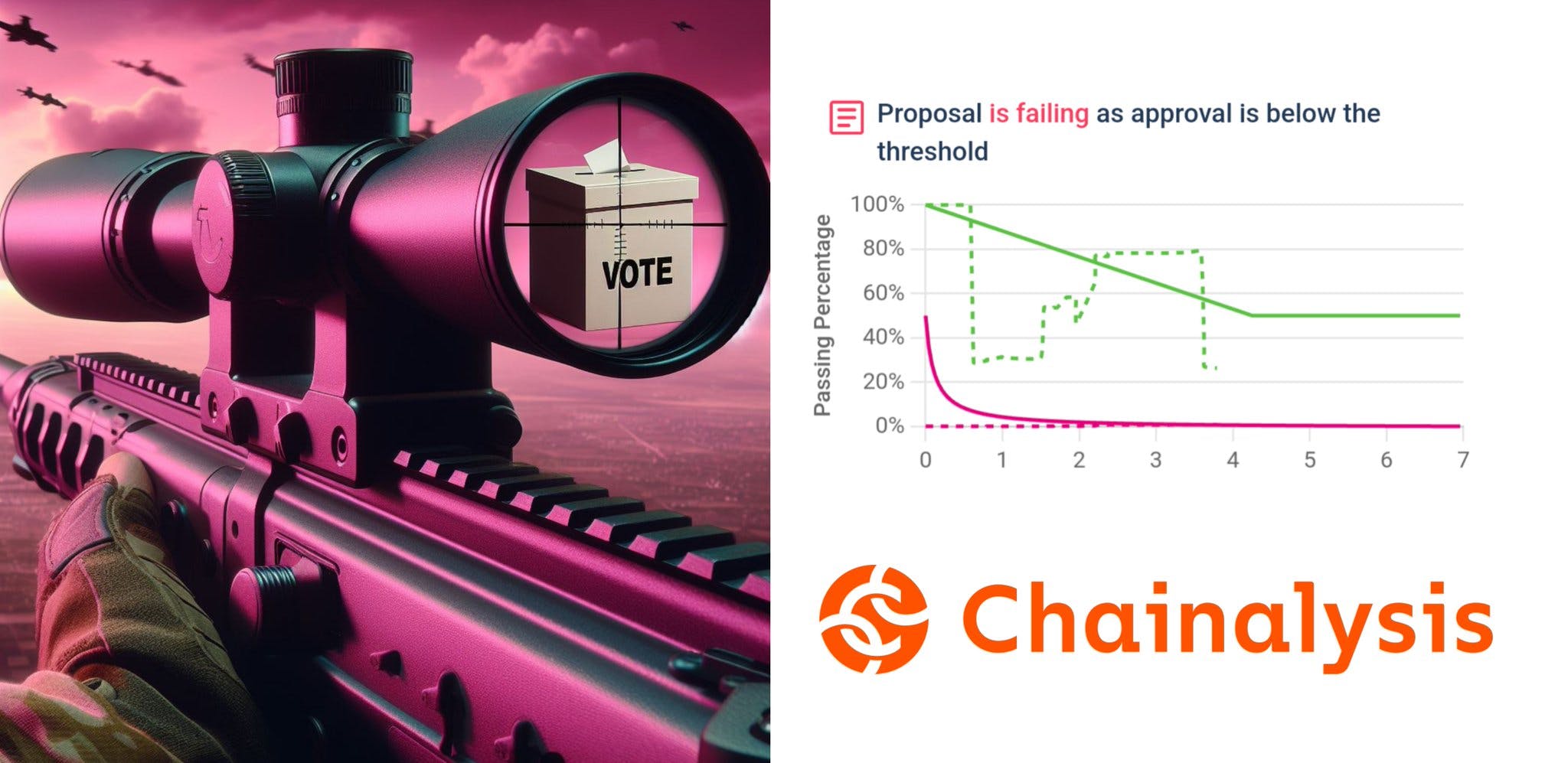
Polkadot Runtime 1.2.4
Polkadot Runtime 1.2.4 has been released on the polkadot-fellows repository. This runtime initiates the new Polkadot Ambassador Program as defined in Referendum 487. Other highlights include: -Allowing arbritrary XCM execution on Kusama. -Upgrading the xcm pallet to facilitate moving bridged assets around the ecosystem. -A vesting pallet for Asset Hub.
Polkadot Academy 5: Singapore Showdown
The fifth wave of the Polkadot Blockchain Academy (PBA) has kicked off in Singapore. Featuring both in-person and remote students this time, it is the biggest cohort ever. PBA alumni can be found working at the Web3 Foundation, Parity, and scattered throughout Polkadot ecosystem projects.
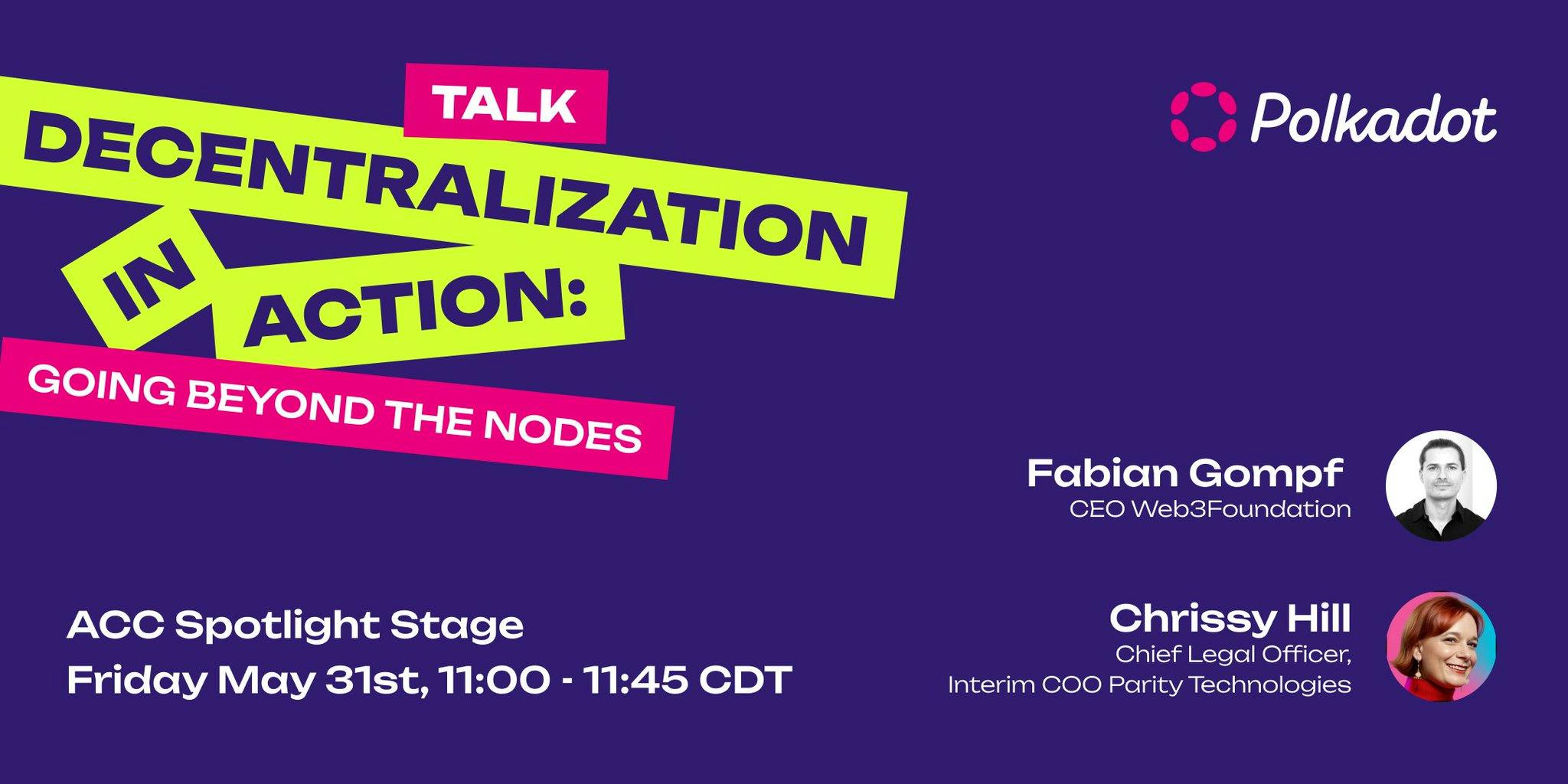
Decentralization in Action: Going Beyond the Nodes
🗓️ Friday 31st May 2024, 11:00-11:45 CDT 📍 ACC Spotlight Stage, Consensus 2024, Austin Web3 Foundation CEO Fabian Gompf and Parity Technologies Interim COO Chrissy Hill discuss their passion for decentralization and how Web3 projects can empower communities.

Referendum #755 MOU for Strategic Partnership with Founder Institute
Polkadot Head Ambassador Irina Karagyar has signed a MOU with the Founder Institute and is seeking the support of the community via Referendum #755 on the OpenGov Wish for Change track. The Founder Institute is the world’s largest pre-seed startup accelerator. Founder Institute Alumni have raised a total $1.75 billion in funding to create a portfolio of companies worth in excess of $30 billion. The MOU proposes a strategic collaboration with Polkadot for the inaugural Web3 cohort of their pre-seed acceleration Core Program. Web3 Startup founders in the cohort will be able to benefit from the mentorship of Polkadot ecosystem experts, while Polkadot gains the opportunity to showcase its technology to promising new projects and build its presence in the Founder Institute network.


Polkadot and Its Firs Hong Kong Web3 Accelerator collaboration
The Founder Institute partners with Polkadot to launch the first Web 3.0 cohort in Hong Kong, combining startup acceleration with cutting-edge blockchain tech. This collaboration offers entrepreneurs access to new technologies and growth opportunities. Polkadot connects specialized blockchains, empowering individuals over internet monopolies. Founded in over 200 cities, the Founder Institute supports startups worldwide with mentorship and a global network.
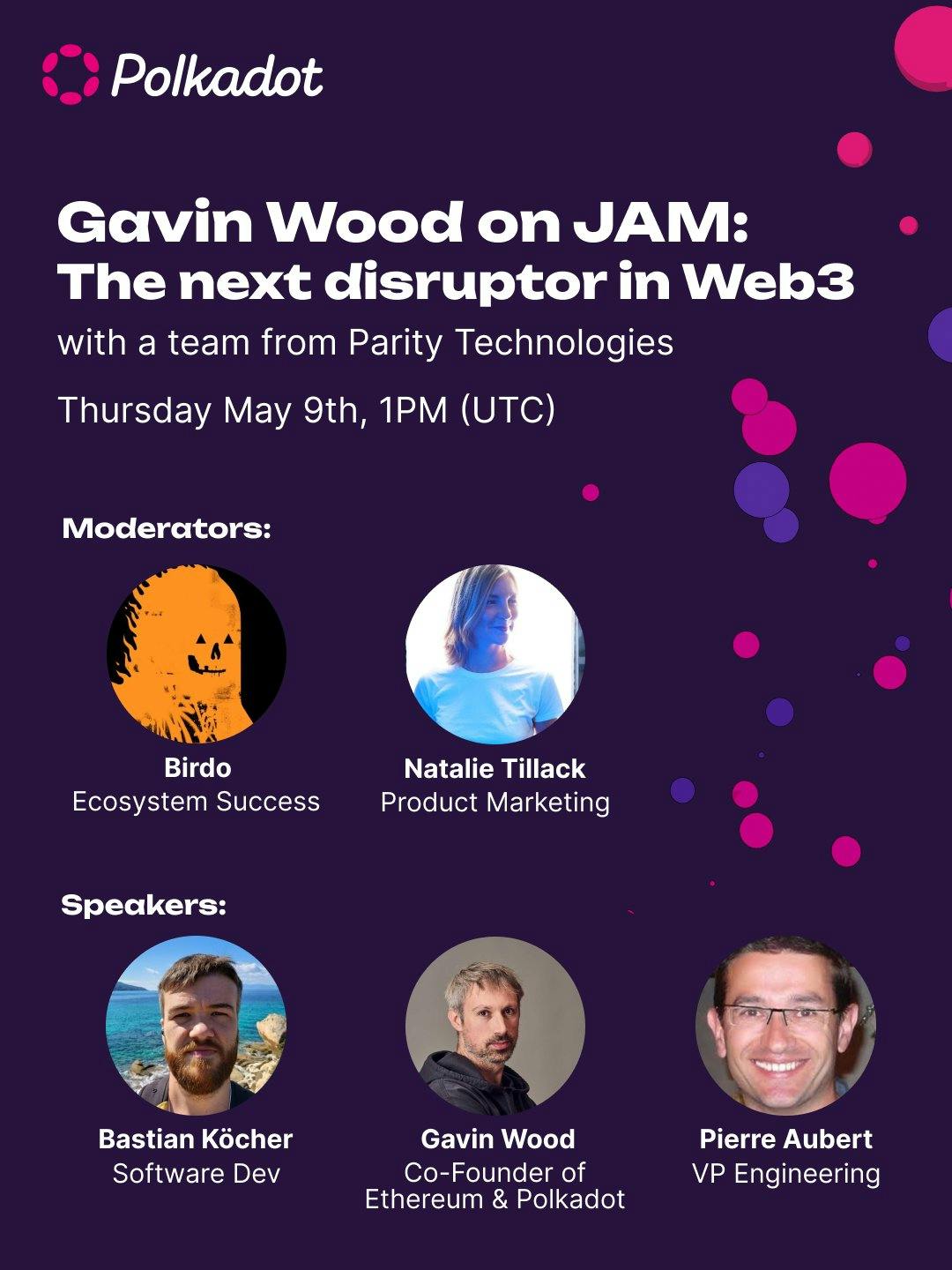


What is JAM? The FUTURE OF POLKADOT
In this video and thread I show what JAM is, its theory, the news it will bring to the Polkadot ecosystem, advantages and benefits for users and developers, comparisons with other blockchains such as solana and ethereum, problems of those blockchains that are not presented in JAM and how JAM seeks to help those blockchains solve these problems through the incredible interoperability of this technology and much more.

How Polkadot's Coretime enables scale, agility and better UX
🗓️Thursday April 25th 2024 14:00 UTC 📍X Spaces https://x.com/i/spaces/1mrGmynzNVQGy Hosted by Polkadot. Moderated by Birdo Featuring: Bill Laboon - Web3 Foundation Seun Lanlege - Polytope Labs Phil Lucsok - Lastic Alice und Bob Join some of the Polkadot eco's greatest minds for a discussion on how Coretime will heighten scalability, speed, and user experience.
Southeast Asia Blockchain Week
🗓️ April 22nd-28th 2024 📍 True Icon Hall, Bangkok, Thailand Polkadot is a Gold Sponsor of the SEABW. The Polkadot ecosystem will be represented in three panel discussions: 24th April 16:50 zkSync Stage Bottom-up Game Development by User Generated Content - features Yuki Pan, Community Manager, Moonbeam 25th April 11:50 Aptos Stage Vitalizing DeFi in SEA: Overcoming Hurdles over CeFi -features Thibault Perreard, Strategy/BD Lead, Bifrost 25th April 14:30 Aptos Stage Tools and Applications for the Multi-chain Universe -features Jonathan Dunne, CTO, Talisman

Peering into the Polkadot Ecosystem
🗓️ Thursday 25TH April 2024, 8.30AM-10.00AM EDT 📍 Coingecko hosts a panel to discuss the Polkadot ecosystem featuring: Bill Laboon - Director of Education & Governance Initiatives, Web3 Foundation John Linden - CEO & Co-Founder, Mythical Games Ingo Ruebe - Founder, Kilt Protocol




How to buy PINK with MetaMask in the Moonbeam ecosystem.
The thread includes videos about how to buy PINK step by step. It covers adding the Moonbeam network to MetaMask via , adding PINK to the MetaMask wallet view, swapping GLMR for PINK on StellaSwap, and how to display the price of PINK and the DOT-PINK pool in StellaSwap.

Web3 Foundation, The Road towards Decentralisation
The birth of the decentralised Web, known as Web3, is driven by the Web3 Foundation and Polkadot. They aim to create an Internet for everyone and freed from central authorities. The Web3 Foundation promotes this transformation through technological, educational and governance initiatives. However, there are challenges such as the need to improve understanding of Polkadot to attract investment. The ultimate goal is to make Polkadot a decentralised and self-sustaining ecosystem, promising to redefine digital interactions in a fair and secure way.
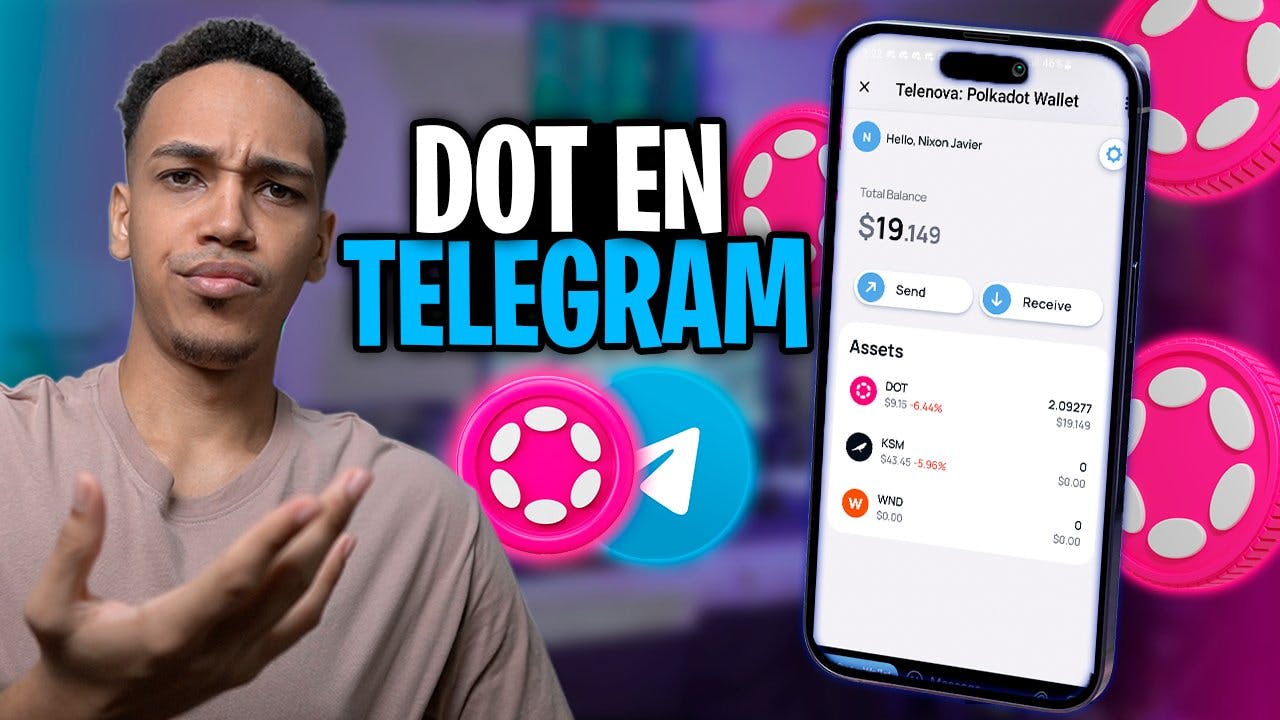


Don't miss out! 🎉
Subscribe to our mail newsletter for free to receive regular updates and support our work- 01Stay up to date with the latest news from the Polkadot Ecosystem
- 02Subscribe on Substack to receive emails